
PAT testing involves a formal visual inspection of each portable appliance, followed by electrical tests with a calibrated PAT tester. Typical tests are earth continuity, insulation resistance and leakage current. Each item then gets a pass or fail label and goes into a written record, usually within a few minutes per appliance.
That sounds simple, but a lot happens in those few minutes. A worn plug, a frayed cable or a failing earth connection can turn a kettle or a heater into a fire or shock risk long before it stops working.
The Electricity at Work Regulations 1989 and the Health and Safety at Work Act 1974 require electrical equipment in workplaces to be kept safe.
Landlords who supply appliances also have a duty to make sure those items are safe for tenants. A portable appliance test is the standard way of showing that you have checked them.
This guide covers each stage of the PAT testing process, from preparing a property to the moment the last label goes on. You’ll find out what the tester looks for, which electrical tests apply to which appliances, what the readings mean and what happens when an item fails.
PAT Testing Process at a Glance: The Five Stages

(For Illustration Purposes Only)
The PAT testing process has five stages: preparation, a formal visual inspection, electrical testing, a functional check, then labelling and record keeping.
This sequence follows the approach in the Institution of Engineering and Technology (IET) Code of Practice for In-Service Inspection and Testing of Electrical Equipment, which many testers use.
| Stage | What Happens | Applies To |
|---|---|---|
| 1. Preparation | Appliances listed, access arranged | All items |
| 2. Formal visual inspection | Plug, cable, casing and fuse checked by eye | All items |
| 3. Electrical testing | Calibrated PAT tester runs set tests | Class I, Class II and leads |
| 4. Functional check | Appliance switched on to confirm it runs safely | Most items |
| 5. Labelling and records | Pass or fail label fitted, results logged | All items |
A tester never plugs an appliance into the PAT tester until the visual inspection is complete, because a cracked plug or exposed wire can be dangerous to test.
Competence and Equipment for a Portable Appliance Test

(For Illustration Purposes Only)
A portable appliance test should be carried out by a competent person: someone with the training, knowledge and equipment to inspect and test appliances safely and read the results correctly.
The law does not name a single qualification, but City and Guilds 2377 is the recognised industry course.
The Electricity at Work Regulations 1989 focus on competence rather than a specific certificate. In practice, that means a tester should:
- Understand the IET Code of Practice and how it applies to different appliance types.
- Know the difference between Class I and Class II construction.
- Use a PAT tester that has been calibrated within the last 12 months, which is common practice.
- Read and record readings accurately, then act on any failures.
The equipment matters as much as the person. A basic pass or fail tester gives a simple green or red light, while a more advanced unit records actual readings and can download results straight into a PAT test report.
Professional testers tend to use the second type, because measured readings show whether an appliance is borderline or comfortably within limits.
Medical electrical equipment falls under a separate standard, BS EN 62353, and needs testers trained for that work. Standard rental property appliances do not fall into this category.
Before the Visit: How to Prepare for PAT Testing

(For Illustration Purposes Only)
Preparing for PAT testing means listing every portable appliance you supply, arranging access with your tenants and making sure each item can be unplugged.
Good preparation cuts the visit time and avoids missed appliances that need a second trip.
Start with an inventory. Walk through the property and note every item with a plug that you, as the landlord, have provided. Common examples include:
- Kettle, toaster and microwave
- Fridge freezer and washing machine
- Vacuum cleaner and iron
- Lamps, heaters and extension leads
Tenants’ own belongings are their responsibility, so testers usually only check landlord-supplied items unless you agree otherwise.
The Landlord and Tenant Act 1985 gives tenants the right to at least 24 hours’ written notice before an inspection visit. Many landlords give more notice than this and confirm a time slot the day before.
| Stage | Landlord Task | Tester Task |
|---|---|---|
| Before the visit | List appliances, give tenants notice | Confirm appliance count and access |
| During the visit | Arrange access, leave items reachable | Inspect, test and label each item |
| After the visit | Repair or replace failed items, keep the record | Issue the PAT test report |
One practical tip: ask tenants to save any work on computers or laptops before the visit. Testers need to unplug each item, and switching off a running PC without warning can lose unsaved files.
The Formal Visual Inspection
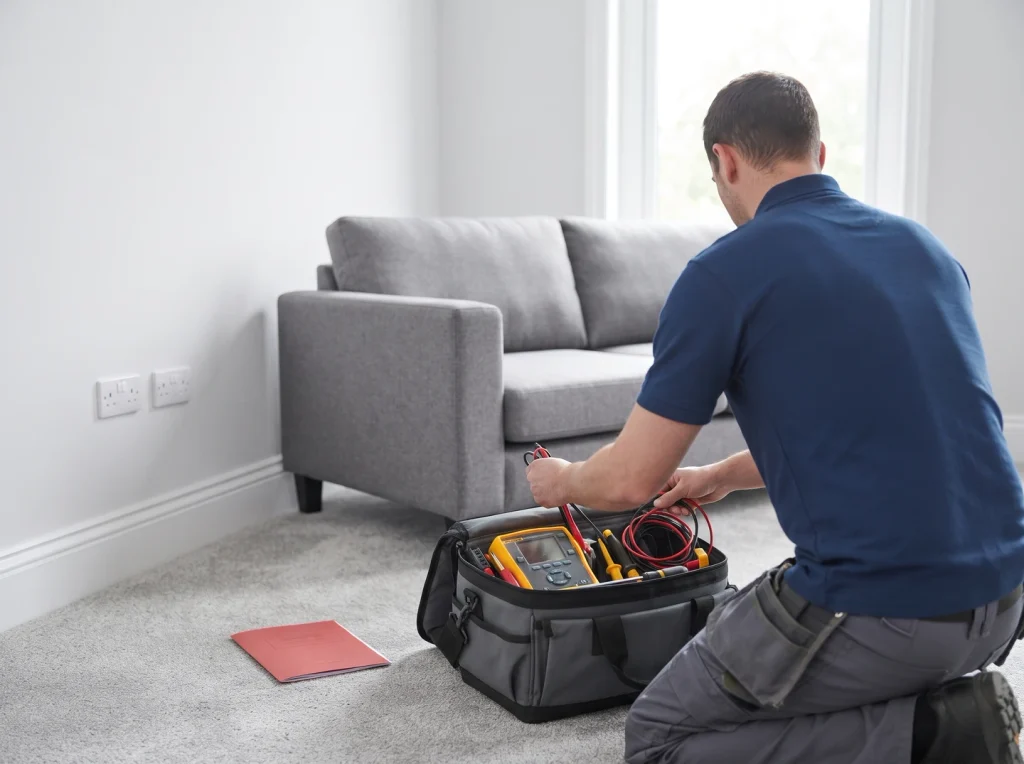
(For Illustration Purposes Only)
The formal visual inspection is a careful check of each appliance’s plug, cable, casing and fuse for damage, wear or signs of overheating.
It comes first because many faults are visible without any test equipment, and HSE guidance points out that a visual check catches a large share of appliance defects.
During this stage, the tester carries out:
- Plug checks for cracks, loose pins and scorch marks
- Cable checks for cuts, fraying, kinks and taped repairs
- Cord grip checks to confirm the outer sheath is held firmly at the plug and appliance
- Fuse checks to confirm the correct rating for the appliance
- Casing checks for cracks, missing screws and exposed internal parts
- Overheating checks for discolouration or melted plastic around plugs and sockets
The tester also opens standard rewireable plugs to confirm the wires are connected to the right terminals and the screws are tight. Moulded plugs can’t be opened, so they get a closer external check instead.
Testers also look at where each appliance is used. A kettle kept beside a sink, or an extension lead run under a rug, may pass its electrical tests but still be used in a way that creates risk. A good tester notes these points on the record so you can act on them.
Identifying the Appliance Class

(For Illustration Purposes Only)
Before running any electrical tests, the tester identifies whether the appliance is Class I or Class II, because the class decides which tests apply.
Using the wrong test can give a false reading or even damage some equipment.
Class I appliances rely on an earth connection for protection and usually have exposed metal parts. Toasters, kettles with metal bodies, irons and washing machines often fall into this group.
Class II appliances are double insulated, carry a square-within-a-square symbol on the rating plate and do not use an earth connection.
| Test | Class I (Earthed) | Class II (Double Insulated) |
|---|---|---|
| Formal visual inspection | Yes | Yes |
| Earth continuity | Yes | No |
| Insulation resistance | Yes | Yes |
| Protective conductor or substitute leakage | Yes | No |
| Touch current | No | Where metal parts are exposed |
| Functional check | Yes | Yes |
Extension leads and IEC leads, such as kettle leads and computer power cables, are treated as a separate category. They get their own set of checks, including a polarity test, which we cover below.
How Do You PAT Test an Appliance Electrically?
To PAT test an appliance electrically, the tester plugs it into a calibrated PAT tester, connects a test lead to any earthed metal part and runs a set of measured tests.
The main ones are earth continuity, insulation resistance and a leakage current test, chosen according to the appliance class.
Earth Continuity Test
The earth continuity test, sometimes called an earth bond test, measures the resistance of the earth path from the plug’s earth pin to the appliance’s metal casing.
A low reading shows the earth will carry fault current safely if something goes wrong inside the appliance.
Insulation Resistance Test
The insulation resistance test applies a DC voltage, normally 500 V, between the live parts and the earth or casing. A high reading means the insulation is doing its job.
Testers often use a lower voltage or a substitute leakage test on IT equipment with surge protection, which can give misleading insulation readings.
Leakage and Touch Current Tests
Leakage tests measure how much current escapes from the live parts during normal use. For Class I items, this is the protective conductor current or substitute leakage test.
For Class II items with exposed metal, the touch current test measures what could flow through a person touching the casing.
| Test | What It Checks | Typical Pass Limit (IET Code of Practice) |
|---|---|---|
| Earth continuity | Earth path from plug to metal casing | 0.1 Ω plus cable resistance |
| Insulation resistance (Class I) | Insulation between live parts and earth | At least 1 MΩ |
| Insulation resistance (Class II) | Insulation between live parts and casing | At least 2 MΩ |
| Protective conductor current | Current leaking to earth in use | 0.75 mA for many portable items |
| Touch current | Current through exposed metal on Class II | 0.25 mA |
Polarity and Functional Checks
Extension leads and IEC leads get a polarity test to confirm live and neutral are wired the right way round. Finally, the tester switches each appliance on briefly to confirm it runs normally without unusual smells, sparks or noise.
How to PAT Test Common Rental Appliances
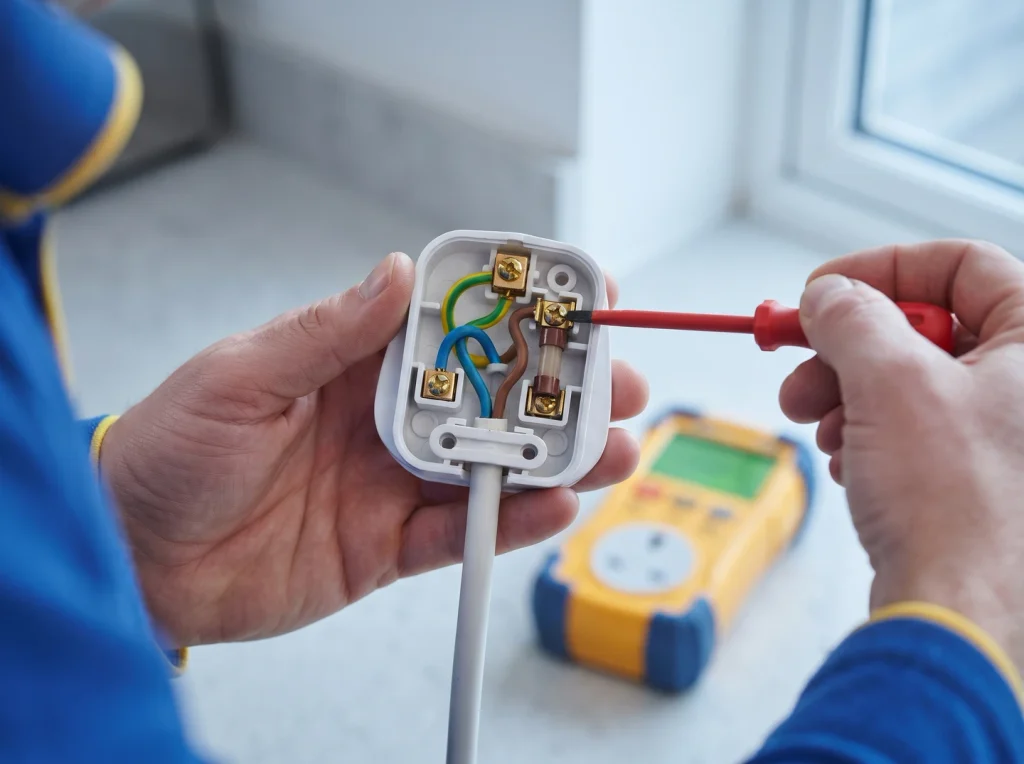
(For Illustration Purposes Only)
How to PAT test an appliance depends on its type, size and how it is used, so testers adjust the process for different items. Here is how the most common rental property appliances are handled.
Kettles and Toasters
These are high-use, high-risk items in a busy kitchen. Kettles with metal bodies and toasters are usually Class I, so they get the full earth continuity, insulation resistance and leakage tests.
The tester also checks for water damage around the base and crumbs or scorching inside the toaster’s plug and cable entry.
Extension Leads
To PAT test an extension lead, the tester inspects every socket, the cable and the plug, then runs earth continuity, insulation resistance and polarity tests on each outlet.
Leads with cracked sockets or cables that have been coiled tightly while in use often fail at the visual stage.
Laptops, Chargers and IT Equipment
Laptop chargers are usually Class II, while desktop computers and many monitors are Class I. On Class I IT equipment, testers commonly use a low test current for earth continuity and a substitute leakage test rather than a full 500 V insulation test, which could damage surge protection components.
Fridges and Washing Machines
Large appliances are tested where they stand. The tester checks the plug and visible cable, then runs the tests without moving the appliance unless access to the plug requires it.
Labels, Records and the PAT Test Certificate
Once testing is complete, each appliance gets a pass or fail label, and every result goes into a written PAT test report, often called a PAT test certificate. The record is your evidence that each landlord-supplied appliance was checked.
A pass label usually shows the date of the test, the tester’s ID or initials and a recommended retest date. Fail labels are normally red and clearly marked so nobody uses the item by mistake.
The PAT test report typically lists:
- The property address and date of testing
- A unique ID and description for each appliance
- The appliance class and location in the property
- Each test carried out and the reading recorded
- A pass or fail result with notes on any defects
- The tester’s name and the PAT tester’s calibration date
Keep this record somewhere you can find it quickly. Letting agents, insurers and local authorities handling HMO licences may ask to see it, and a clear log makes it easy to track which items are due for a retest.
What Happens When an Appliance Fails?
When an appliance fails a PAT test, the tester labels it as failed, records the reason and advises that it is taken out of use straight away. You then need to repair it or replace it before tenants use it again.
Some failures are simple to fix. A wrong fuse rating, a loose plug terminal or a damaged plug top can often be corrected by the tester during the visit, then the appliance is retested and, if it passes, labelled accordingly.
Other failures mean the appliance should go. Common examples include:
- A damaged or cut cable on a moulded lead
- A cracked casing exposing internal parts
- An insulation resistance reading well below the limit
- An earth continuity reading showing a broken earth path
Tell your tenants which items failed and when replacements will arrive. A short written note avoids confusion and stops anyone plugging the old item back in.
Where PAT Testing Fits in Landlord Compliance
PAT testing is not a specific legal requirement for private landlords in England, but it is the recognised way to show that the appliances you supply are safe.
The Electricity at Work Regulations 1989 and the Health and Safety at Work Act 1974 apply mainly to workplaces, so they cover offices, shops and communal areas run as a business.
For rented homes, electrical hazards are one of the risks assessed under the Housing Health and Safety Rating System in the Housing Act 2004, and some HMO licences ask for PAT records as a licence condition.
PAT testing only covers plug-in items, so many landlords book it alongside their five-yearly electrical inspection, which checks the fixed wiring, sockets and consumer unit.
In practice, a dated PAT test report gives you evidence of due diligence if a tenant, insurer or local authority raises concerns about an appliance.
That record carries real weight in a dispute, particularly in high-turnover properties such as HMOs and short lets.
What PAT Testing Involves: Final Thoughts
PAT testing involves far more than plugging an appliance into a box and waiting for a green light.
A proper test starts with a careful visual inspection, moves through earth continuity, insulation resistance and leakage tests matched to the appliance class, and finishes with labels and a clear written record.
For landlords, the value sits in that record. It shows which appliances were checked, what the readings were and what action you took on any failures.
If you supply furnished or part-furnished homes, build PAT testing into your regular property checks rather than waiting for a problem.
Keeping appliance records up to date between tenancies makes compliance far easier, especially in properties where tenants change often.
Book PAT Testing With EICR Landlord Cert Ltd
EICR Landlord Cert Ltd, based at 128 City Road, London, EC1V 2NX, provides PAT testing by City and Guilds 2377 qualified engineers who are DBS checked and covered by public liability insurance, across all 32 London boroughs. We offer same-day inspections subject to availability, and your PAT test report is sent digitally once the inspection is complete. PAT testing starts from £69, and you can book on 0203 633 9146, Monday to Friday, 9:00 AM to 6:00 PM.
Frequently Asked Questions
What is PAT testing?
PAT testing, short for portable appliance testing, is the in-service inspection and testing of electrical appliances that plug into a socket.
It combines a formal visual inspection with electrical tests such as earth continuity, insulation resistance and leakage current, carried out using a calibrated PAT tester.
Each appliance receives a pass or fail label, and the results go into a written record. Many testers follow the IET Code of Practice for In-Service Inspection and Testing of Electrical Equipment.
Is PAT testing a legal requirement for landlords?
PAT testing is not a specific legal requirement for private landlords in England. However, landlords must make sure any appliances they supply are safe, and electrical hazards are assessed under the Housing Health and Safety Rating System in the Housing Act 2004.
Some HMO licences require PAT records as a condition. In workplaces, the Electricity at Work Regulations 1989 require electrical equipment to be maintained in a safe condition, and PAT testing is the usual way to show this.
How long does PAT testing take?
Each appliance usually takes a few minutes to inspect, test and label, depending on its type and class.
A furnished flat with 10 to 20 appliances often takes between 30 minutes and an hour. Larger HMOs with shared kitchens and many extension leads can take longer.
Having a list of appliances ready and clear access to plugs reduces the time needed. Landlords can call 0203 633 9146 to arrange a visit.
What appliances need PAT testing?
Any portable electrical appliance with a plug that a landlord or employer supplies can be PAT tested.
In rental properties, this commonly includes kettles, toasters, microwaves, fridge freezers, washing machines, tumble dryers, vacuum cleaners, irons, lamps, heaters and extension leads.
IEC leads, such as kettle leads and computer power cables, are also tested. Appliances that belong to tenants are normally the tenant’s responsibility and are not included unless agreed in advance.
Can anyone do PAT testing?
Anyone carrying out PAT testing must be competent, meaning they have the knowledge and experience to inspect appliances, use a calibrated PAT tester correctly and interpret the results.
The Electricity at Work Regulations 1989 set this competence duty but do not name a specific qualification.
City and Guilds 2377 is the recognised industry qualification for PAT testers. Landlords without training risk missing faults or misreading results, which defeats the purpose of the test.
What are the pass and fail criteria for PAT testing?
An appliance passes if it shows no visible damage and its electrical readings fall within the limits set out in the IET Code of Practice.
Typical limits are an earth continuity reading of 0.1 Ω plus cable resistance, insulation resistance of at least 1 MΩ for Class I or 2 MΩ for Class II, and leakage current below set thresholds.
Any visible defect, such as a cracked plug or damaged cable, is a fail.
How long is a PAT test certificate valid?
A PAT test certificate has no fixed legal expiry date. The IET Code of Practice recommends retest intervals based on the type of appliance, how often it is used and the environment it is used in.
Many landlords retest appliances annually or at the start of each new tenancy.
Higher-risk items, such as kettles and extension leads in busy HMO kitchens, may benefit from more frequent checks.
Do I need to PAT test new equipment?
New appliances do not usually need a full PAT test, because manufacturers test them before sale under product safety standards.
The IET Code of Practice suggests a visual check before first use, along with adding the item to your appliance register.
Some landlords prefer to have new items labelled and recorded at the next scheduled visit so that every appliance in the property appears on one up-to-date record.