
Landlords face fines of up to £30,000 for failing to keep a valid EICR. An EICR is required every five years for private rented properties under the Electrical Safety Standards (Private Rented Sector) Regulations 2020, and the clock starts from the date of the last satisfactory inspection.
That five-year rule sounds simple enough. But the reality catches out more landlords than you’d expect.
Properties with older wiring, HMOs with higher occupancy, and buildings flagged with observation codes can all change the timeline. A landlord who assumes “five years and forget about it” risks both penalties and genuine electrical hazards.
This guide breaks down exactly how often an EICR needs to be done, when the five-year rule applies, which properties may need more frequent inspections, and what triggers an earlier renewal. You’ll also find the specific regulations that set these deadlines, what happens if your EICR expires, and how the process works for rental properties.
What Is an EICR and Why Does It Have a Renewal Period?
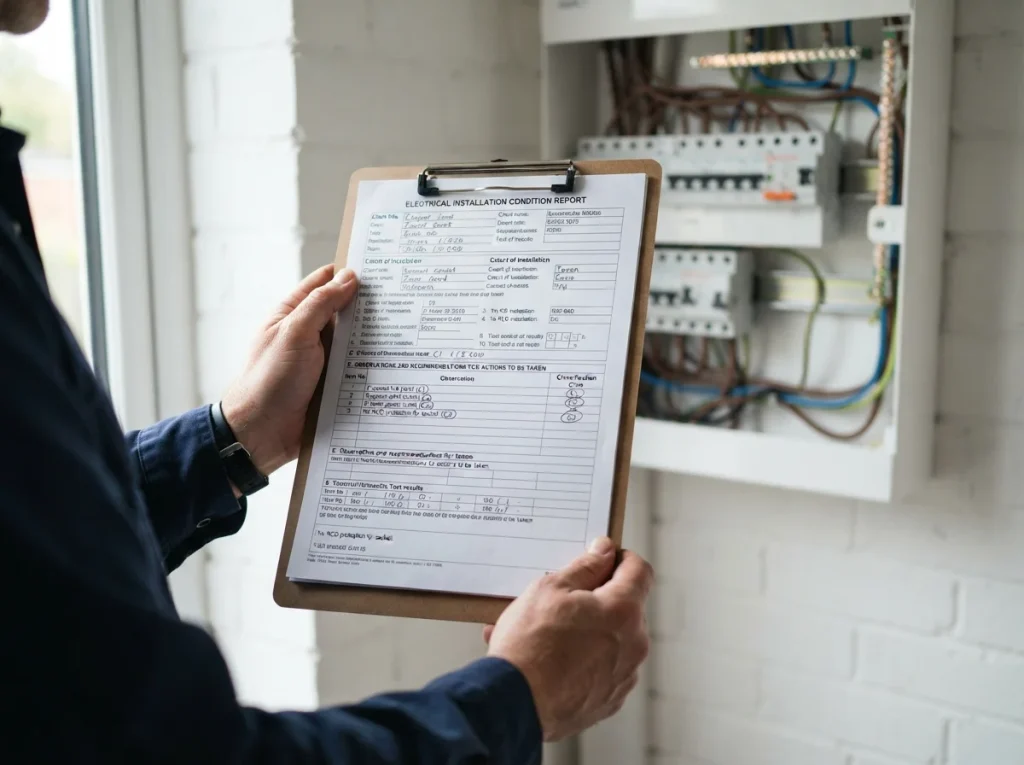
(For Illustration Purposes Only)
An EICR (Electrical Installation Condition Report) is a formal inspection of a property’s fixed electrical installation. It covers the wiring, consumer unit, sockets, switches, distribution boards, and earthing arrangements. A qualified electrician carries out visual inspections, dead testing, and live testing to assess whether the electrics are safe and comply with BS 7671 wiring regulations.
The report assigns observation codes to any issues found. C1 means danger is present and requires immediate action. C2 means a fault is potentially dangerous and needs urgent remedial work. C3 means improvement is recommended but not mandatory. FI means further investigation is required.
Because electrical installations deteriorate over time, the regulations set a maximum inspection interval. Wiring insulation breaks down, connections loosen, RCDs can fail, and circuit breakers degrade. A periodic inspection report catches these problems before they become fire risks or electrocution hazards.
How Often Does an EICR Need to Be Done for Rental Properties?
(For Illustration Purposes Only)
For private rented properties in England, landlords must have an EICR carried out at least every five years. This is a legal requirement under the Electrical Safety Standards (Private Rented Sector) Regulations 2020, which came into force on 1 June 2020.
The five-year cycle applies to all private rented tenancies, including assured shorthold tenancies and licences to occupy. It covers every type of rental property, from studio flats and terraced houses to large portfolio buildings.
Your EICR certificate will state the recommended date for the next inspection. In most cases, this will be five years from the inspection date. However, the inspecting electrician can recommend a shorter interval if they identify concerns with the installation’s condition.
What Determines the Inspection Interval?
The electrician carrying out the electrical installation condition report decides the recommended next inspection date based on several factors.
The age and condition of the wiring plays the biggest role. A property rewired within the last 10 years with a modern consumer unit and RCD protection will typically receive the full five-year recommendation. A property with ageing wiring from the 1970s or 1980s might receive a three-year recommendation, even if it passes.
The type of occupancy matters too. HMO properties with higher footfall and more electrical demand often warrant shorter intervals. Commercial properties follow different guidelines entirely.
Environmental conditions also factor in. Properties prone to damp, those with external installations, or flats above commercial kitchens may need more frequent checks because moisture accelerates wiring deterioration.
EICR Frequency by Property Type
Not all properties follow the same five-year schedule. The table below shows the recommended EICR frequency for different property types based on the IET wiring regulations and industry best practice.
| Property Type | Recommended EICR Frequency | Regulatory Basis |
|---|---|---|
| Private rented (standard tenancy) | Every 5 years (maximum) | Electrical Safety Standards 2020 |
| HMO (House in Multiple Occupation) | Every 5 years (legally), 3 years recommended | Housing Act 2004 + best practice |
| Change of tenancy | Before new tenants move in if previous EICR has expired | Electrical Safety Standards 2020 |
| Commercial property | Every 5 years | BS 7671 guidance |
| Domestic (owner-occupied) | Every 10 years (recommended, not mandatory) | BS 7671 guidance |
| Swimming pools or special locations | Every 1 year | BS 7671 special locations |
The five-year maximum is a legal ceiling for rented properties, not a target. If your electrician recommends three years, that shorter interval becomes your deadline.
When Do Landlords Need an EICR Before the Five-Year Mark?

(For Illustration Purposes Only)
Several situations require landlords to arrange an EICR before the standard five-year renewal date.
Before a new tenancy begins. If you’re letting a property for the first time, you must have a valid EICR in place before the tenant moves in. You must also provide a copy of the report to the tenant within 28 days of the inspection.
After major electrical work. If you’ve had a full or partial rewire, a consumer unit replacement, or significant alterations to the fixed wiring, a new EICR should be carried out to verify the work meets current standards. This is separate from the electrical installation certificate that the contractor issues for their own work.
Following a failed EICR. If your report comes back unsatisfactory with C1 or C2 codes, you have 28 days to complete remedial works and obtain a satisfactory report.
The remedial works themselves don’t restart the five-year clock. Your next full EICR is still due based on the date recommended on the report.
When the electrician recommends an earlier date. This is the one landlords most often overlook. The recommended next inspection date on your report is binding. If your electrician writes three years instead of five, that three-year date is when your next EICR is legally due.
If a tenant requests it. Local authorities can require a landlord to produce a valid EICR if a tenant raises concerns about electrical safety. If your current report has expired or the local authority deems it inadequate, you’ll need a new one.
How Long Is an EICR Valid For?
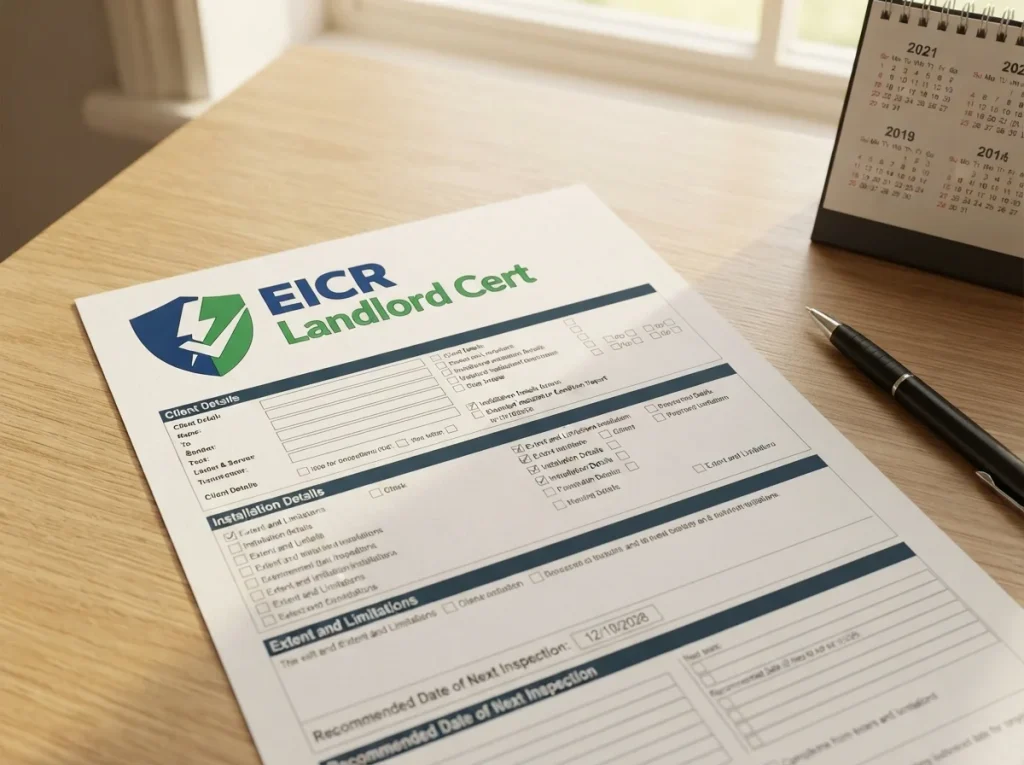
(For Illustration Purposes Only)
An EICR is valid for the period stated on the report itself, up to a maximum of five years for rented properties. The validity period is not automatically five years. It is whatever the qualified electrician recommends based on the condition of the installation.
Most rental properties with modern electrics will receive the full five-year validity. But properties with older fixed wiring, aluminium cable, outdated earthing arrangements, or a high number of C3 observations may receive a shorter validity period.
The date that matters is the “recommended date of next inspection” printed on the report. Mark this date in your property management calendar and arrange the next inspection at least four to six weeks before it expires. EICR inspections get booked up quickly, especially in the spring and autumn letting seasons.
Does an EICR Expire on the Exact Date?
Yes. Once the recommended next inspection date passes, your EICR is no longer considered valid. There is no grace period built into the Electrical Safety Standards 2020.
If your local authority requests evidence of a valid electrical safety certificate and yours has expired, you could face enforcement action. Penalties under the regulations can reach up to £30,000 per breach.
The practical approach is to treat your EICR renewal like your gas safety record. Set a reminder for 8 to 12 weeks before expiry and book early.
What Happens If a Landlord Doesn’t Renew Their EICR on Time?
Failing to maintain a valid EICR carries serious consequences under the Electrical Safety Standards (Private Rented Sector) Regulations 2020.
Local authorities can issue a remedial notice requiring you to obtain a satisfactory report within 28 days. If you fail to comply, the local authority can arrange the inspection themselves and recover costs from you, plus issue a financial penalty of up to £30,000.
Beyond the fine, operating without a valid electrical safety certificate creates liability exposure. If a tenant is injured by an electrical fault and you don’t hold a current EICR, your insurance claim could be rejected. Your letting agent may also refuse to manage the property without one.
For HMO landlords, the stakes are even higher. An HMO licence typically requires a valid EICR as a condition of the licence. Letting the EICR expire could put your licence at risk, which would make the entire operation unlawful.
How the EICR Inspection Process Works
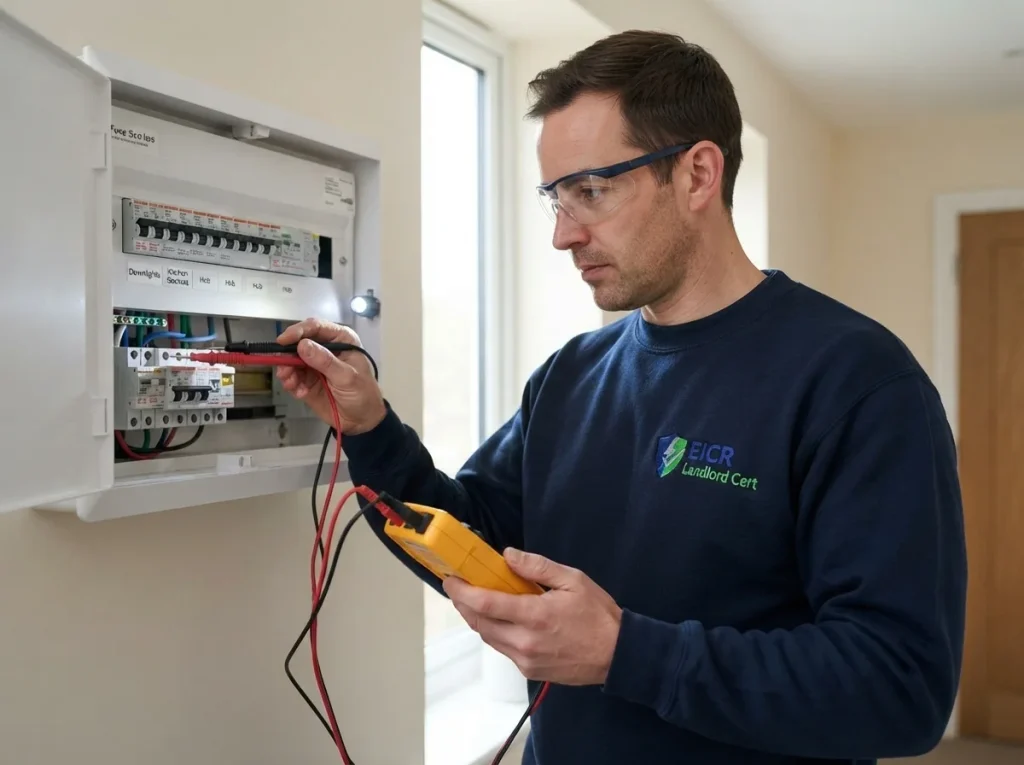
(For Illustration Purposes Only)
Understanding what happens during an EICR helps landlords plan around the inspection and avoid unnecessary delays.
A qualified NICEIC-approved electrician will attend the property and work through a systematic inspection of the fixed electrical installation. This covers the consumer unit, all circuits, socket outlets, light fittings, switches, and the earthing and bonding arrangements.
The inspection involves three stages. First, a visual inspection of all accessible parts of the installation, checking for damage, deterioration, and non-compliance.
Second, dead testing with the power isolated, measuring insulation resistance, continuity, and polarity. Third, live testing to check RCD operation, earth fault loop impedance, and circuit functionality.
For a typical flat with 8 to 10 circuits, the inspection takes two to four hours. Larger properties and HMOs take longer. The electrician will need access to the consumer unit and every room, so you’ll need to coordinate with tenants in advance.
Once testing is complete, the electrician issues the report, either as satisfactory (no C1 or C2 codes) or unsatisfactory (one or more C1 or C2 codes requiring remedial work within 28 days).
How to Keep Track of Your EICR Renewal Dates

(For Illustration Purposes Only)
Landlords managing multiple properties need a reliable system for tracking when each EICR is due. Here’s what works in practice.
Record the “recommended next inspection date” from every EICR report in a single spreadsheet or property management system. Don’t rely on the report sitting in a drawer.
Set two reminders for each property. The first is at 12 weeks before expiry, to start getting quotes and booking the inspection. The second is at 6 weeks before expiry, as a final deadline to have the inspection completed with time for any remedial works.
Keep digital copies of every EICR. You’re required to provide a copy to your tenant within 28 days and to your local authority within seven days if they request one. Having reports accessible on your phone or laptop saves time and avoids scrambling through paperwork.
If you use a letting agent, confirm in writing that they are tracking EICR renewal dates on your behalf. The legal obligation sits with the landlord, not the agent. If the EICR lapses, the fine comes to you.
Book Your EICR With EICR Landlord Cert
EICR Landlord Cert provides EICR inspections across all 32 London boroughs, with appointments available Monday to Friday for flats, houses, and HMO properties. Every inspection is carried out by NICEIC-approved, DBS-checked electricians with public liability insurance, covering everything from studio flats to large multi-unit buildings. Inspections start from £85, with same-day inspections available for landlords who need to act quickly. Call 0203 633 9146 to book your inspection or discuss your property’s requirements.
Frequently Asked Questions
How often does a landlord need an EICR?
Landlords must have an EICR carried out at least every five years under the Electrical Safety Standards (Private Rented Sector) Regulations 2020. The exact interval is set by the inspecting electrician and printed on the report. If the electrician recommends a shorter period, such as three years for older wiring, that shorter period becomes the legal deadline. There is no grace period once the recommended date passes.
How long is an EICR certificate valid for?
An EICR is valid for up to five years for rented properties, but the actual validity depends on the date the electrician writes on the report. Properties with modern electrics and a satisfactory outcome typically receive the full five years. Older installations or those with multiple C3 observations may receive a shorter validity period of three years. The “recommended date of next inspection” on the report is the date that counts.
What happens if my EICR expires?
If your EICR expires, you are in breach of the Electrical Safety Standards 2020. Your local authority can issue a remedial notice requiring you to obtain a satisfactory report within 28 days. Failure to comply can result in a financial penalty of up to £30,000. Your letting agent may also refuse to manage the property, and your landlord insurance could be affected if a claim relates to an electrical fault.
Do I need a new EICR for every new tenant?
You do not need a new EICR for every change of tenancy, provided your current report is still within its validity period and is satisfactory. You must supply a copy of the existing valid EICR to new tenants before they move in. If the report is due to expire during the tenancy, arrange the renewal before the expiry date rather than waiting for the tenancy to end.
Can a landlord carry out their own EICR?
No. An EICR must be carried out by a qualified and competent person, which in practice means an electrician registered with an approved body such as NICEIC, NAPIT, or ELECSA. The regulations specify that the person must be qualified to undertake the inspection and testing of electrical installations to the standard required by BS 7671. A landlord without these qualifications cannot self-certify.
How often does an EICR need to be done on a commercial property?
Commercial properties are not covered by the Electrical Safety Standards 2020, which apply specifically to the private rented sector. However, BS 7671 recommends a five-year inspection interval for commercial premises. Employers and duty holders are legally required to maintain all electrical systems to prevent danger, which makes periodic inspection a practical necessity. Many commercial insurers and local licensing bodies also require a valid EICR.
What is the penalty for not having a valid EICR?
The maximum financial penalty for failing to comply with the Electrical Safety Standards 2020 is £30,000 per breach. Local authorities can also arrange the inspection on your behalf and charge you for the cost. Beyond the financial penalty, operating without a valid EICR creates significant legal liability if a tenant is harmed by an electrical fault. HMO landlords may also risk losing their property licence.
How long does an EICR inspection take?
A typical EICR inspection takes two to four hours for a standard flat with 8 to 10 circuits. Larger properties, HMOs, and houses with more circuits take longer. The electrician needs access to the consumer unit and all rooms, so coordinate with tenants beforehand. Once testing is complete, you’ll receive the report, usually within 24 to 48 hours if no remedial works are needed.
Is an EICR the same as an electrical safety certificate?
Yes. An EICR and a landlord electrical safety certificate refer to the same document. EICR stands for Electrical Installation Condition Report, which is the formal name used in BS 7671. “Electrical safety certificate” is the term most landlords and letting agents use in everyday conversation. Both refer to the periodic inspection report that assesses the condition of a property’s fixed electrical installation. Call 0203 633 9146 if you need to book yours.
Does an EICR cover portable appliances?
No. An EICR covers only the fixed electrical installation, which includes the wiring, consumer unit, sockets, switches, and distribution board. Portable appliances such as kettles, toasters, and extension leads are not covered and require separate PAT Testing. For HMO properties and furnished lets, landlords should consider this when planning their compliance checks.