
An EICR certificate is a formal report that records the condition of the electrical installation in a property, identifying any defects, deterioration, or non-compliance with BS 7671 wiring regulations. EICR stands for Electrical Installation Condition Report.
For landlords, this is not optional. Since 1 June 2020, the Electrical Safety Standards (Private Rented Sector) Regulations 2020 have made it a legal requirement to obtain an EICR before new tenancies begin and to renew it every five years. Failing to comply can result in fines of up to £30,000 per property.
Yet many landlords still confuse an EICR with a simple visual check or mix it up with other certificates. The inspection itself is far more detailed, covering everything from earthing and bonding to RCD protection and circuit identification.
This guide covers exactly what an EICR certificate is, what the inspection involves, who needs one, how long it lasts, what the outcome codes mean, and what happens if your property fails. You’ll find the legal requirements broken down clearly, along with practical advice specific to rental properties.
What Does EICR Stand For?
(For Illustration Purposes Only)
EICR stands for Electrical Installation Condition Report. It is the official document produced after a qualified electrician inspects and tests the fixed electrical installation in a property.
The term replaced older names like “periodic inspection report” and “electrical condition report”, though you may still hear those phrases used. Regardless of the name, the purpose is the same: to assess whether the wiring, sockets, switches, consumer unit, distribution board, and other fixed electrical components are safe and meet current standards.
An EICR is not a repair service. It is a diagnostic assessment. The electrician tests the installation, records the findings, and issues a report that classifies any problems using a standardised coding system.
What Is an EICR Certificate and Why Do You Need One?

(For Illustration Purposes Only)
An EICR certificate is the formal outcome of an electrical installation condition report carried out on a property. It tells you whether the fixed wiring and electrical components are in a satisfactory or unsatisfactory condition.
Legal requirement for landlords
The Electrical Safety Standards (Private Rented Sector) Regulations 2020 require all private landlords in England to have an EICR carried out by a qualified person. The report must be in place before a new tenancy starts and must be renewed at least every five years.
You are legally required to provide a copy of the EICR to existing tenants within 28 days of the inspection and to new tenants before they move in. Your local authority can request a copy at any time, and you must supply it within seven days.
Who needs an EICR?
Private landlords with tenanted properties are legally obligated. But EICRs are also strongly recommended for homeowners, particularly when buying or selling a property, after a major renovation, or if the electrics have not been tested in over ten years.
HMO landlords face additional scrutiny. Local authorities routinely request EICR certificates as part of HMO licensing conditions. Missing or expired reports can block a licence application entirely.
Commercial property owners also benefit from regular electrical inspections, though the legal framework differs slightly from the private rented sector regulations.
What Does an EICR Inspection Involve?
(For Illustration Purposes Only)
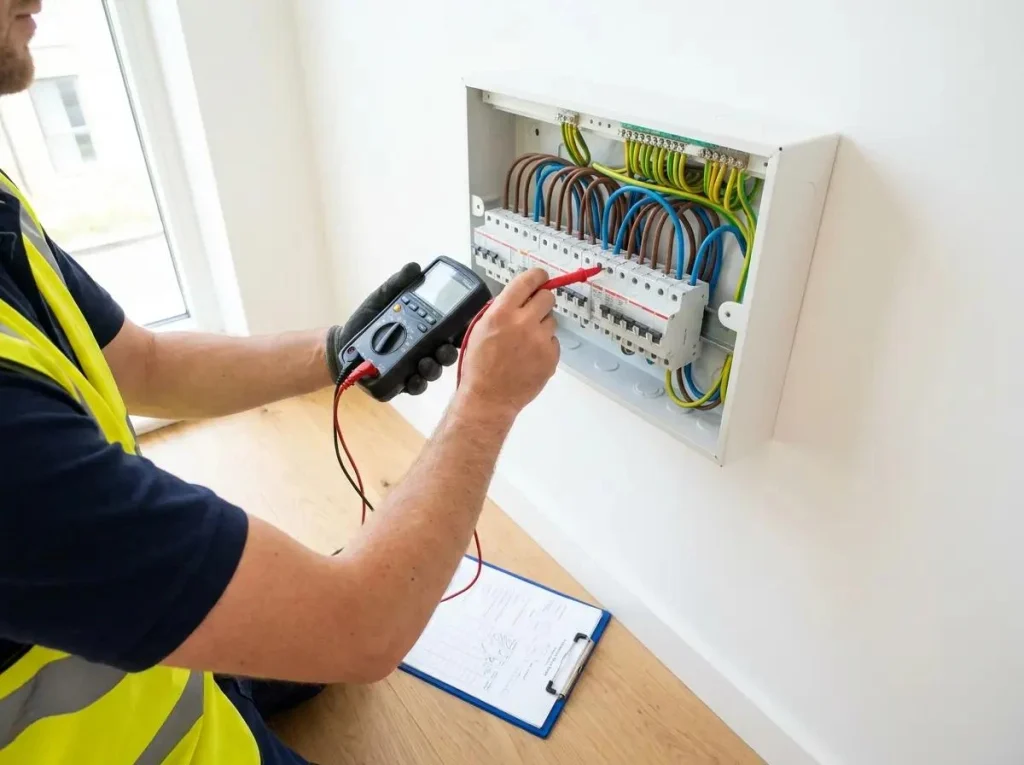
An EICR inspection involves a combination of visual inspection and detailed electrical testing carried out on all fixed electrical installations within the property. The process is thorough and follows the procedures set out in BS 7671, the 18th Edition IET Wiring Regulations.
Visual inspection
The electrician begins by examining the property’s electrical installation without switching anything off. They check for visible signs of damage, deterioration, overloading, or non-compliance. This includes looking at sockets, switches, light fittings, the consumer unit or fuse board, and any exposed wiring.
Signs of scorch marks, cracked faceplates, missing covers, or outdated components are all noted during this stage.
Dead testing
With the power isolated, the electrician carries out a series of tests on the wiring. These include continuity of protective conductors, insulation resistance testing, and polarity checks. Dead testing confirms that the wiring is correctly connected and that the insulation between conductors has not broken down.
Live testing
Once dead tests are complete, the power is restored and the electrician tests the installation under normal operating conditions. This includes earth fault loop impedance testing, RCD trip testing, and prospective fault current measurement. Live testing confirms that protective devices will operate correctly in the event of a fault.
What is actually checked?
The inspection covers every part of the fixed electrical installation. The electrician will test the consumer unit, circuit breakers, residual current devices, ring and radial circuits, lighting circuits, earthing and bonding arrangements, and any fixed appliances permanently connected to the supply.
Portable appliances such as kettles or lamps are not covered by an EICR. Those fall under portable appliance testing, which is a separate process.
How Long Does an EICR Take?
A typical EICR inspection takes between two and four hours for a standard flat or house. The duration depends on the size of the property, the number of circuits, and the age and condition of the electrical installation.
A studio or one-bedroom flat with a modern consumer unit might be completed in under two hours. A three-bedroom house with older wiring and a dated fuse board could take three to four hours. Larger HMO properties or commercial premises may take longer.
During the inspection, the electrician will need to switch the power off for portions of the dead testing phase. This usually lasts 30 to 60 minutes. It is worth letting tenants know in advance.
| Property Type | Estimated Duration |
| Studio or 1-bed flat | 1.5 to 2 hours |
| 2-bed flat or house | 2 to 3 hours |
| 3-bed house | 3 to 4 hours |
| 4+ bed or HMO | 4+ hours |
EICR Outcome Codes Explained
Every EICR report uses a standardised coding system to classify any issues found during the inspection. These codes determine whether the overall outcome is satisfactory or unsatisfactory.
In brief, the codes are C1 (danger present, requiring immediate action), C2 (potentially dangerous, requiring urgent remedial work), C3 (improvement recommended but not mandatory), and FI (further investigation required). Any property receiving a C1 or C2 code will be marked as unsatisfactory overall. Landlords must address C1 and C2 issues within the timeframes set by the regulations to avoid enforcement action. A C3 code does not make the report unsatisfactory but flags areas where the installation could be brought closer to current standards.
How Long Is an EICR Valid For?
(For Illustration Purposes Only)
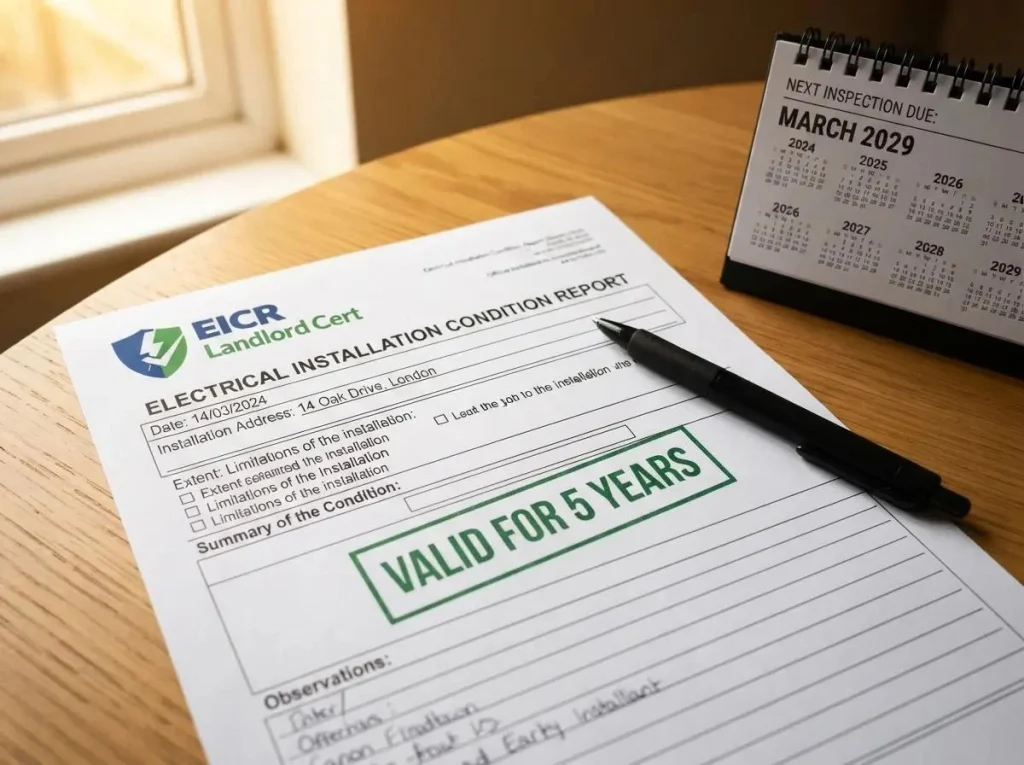
An EICR certificate is valid for five years for rental properties. This is the maximum interval set by the Electrical Safety Standards (Private Rented Sector) Regulations 2020.
The five-year validity applies to all private rented properties in England, including flats, houses, and HMOs. Your EICR report will state the recommended date for the next inspection, and it is the landlord’s responsibility to arrange a new inspection before that date.
For owner-occupied homes, the recommended interval is ten years, though this is advisory rather than legally mandated. For commercial properties, the interval may vary depending on the type of premises and the risk assessment.
If remedial works are carried out following a failed EICR, the original report’s expiry date does not change. The clock starts from the date of the original inspection, not from the date the repairs were completed.
What Happens if Your Property Fails an EICR?
(For Illustration Purposes Only)
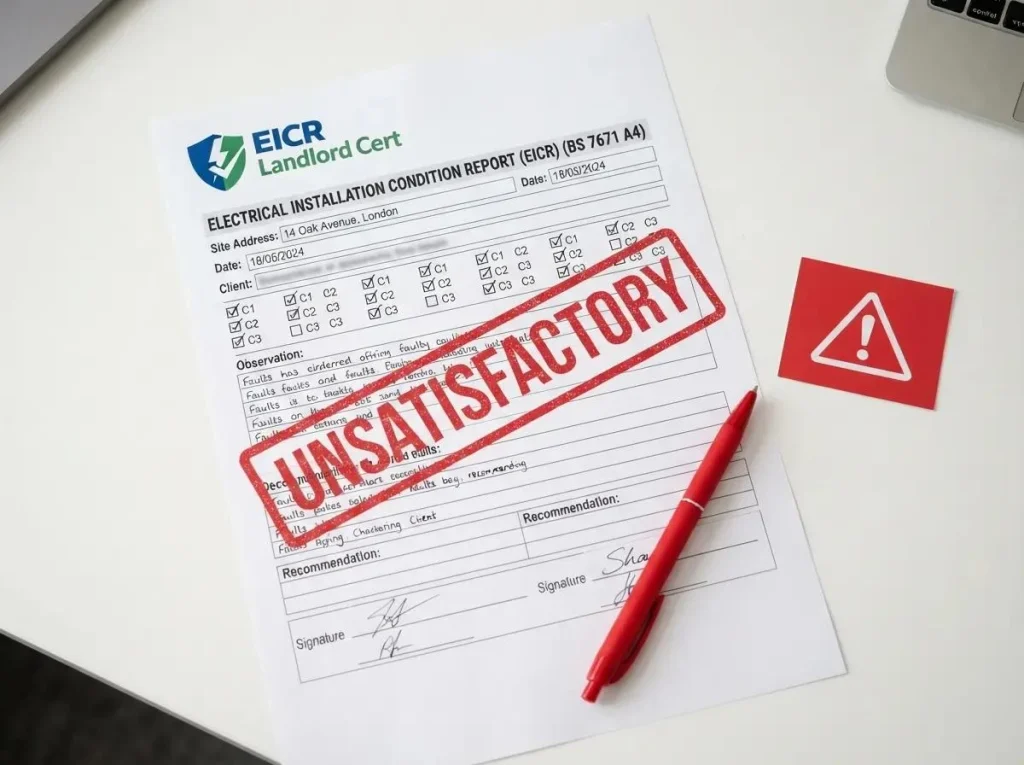
A failed EICR means the electrical installation has been assessed as unsatisfactory. This happens when the report contains one or more C1 or C2 classification codes.
When a property fails, the landlord has 28 days to complete the required remedial works. After the repairs, a qualified electrician must re-inspect and confirm the issues have been resolved. The updated report, or a separate minor electrical works certificate, must then be provided to tenants and the local authority.
Ignoring a failed EICR has serious consequences. Your local authority can issue a remedial notice requiring you to take action. If you still do not comply, the council can arrange for the work to be carried out and charge you for it. Fines can reach up to £30,000, and repeated non-compliance can lead to a banning order under the Housing Act 2004.
Some local authorities have become particularly active in enforcement, regularly auditing landlord compliance as part of their licensing programmes.
Who Can Carry Out an EICR?

(For Illustration Purposes Only)
An EICR must be carried out by a qualified and competent person. The regulations specify that the electrician must be registered with a recognised competent person scheme.
Accepted schemes include NICEIC, NAPIT, and ELECSA. Registration with one of these bodies confirms that the electrician has the qualifications, insurance, and competence to inspect and test electrical installations in line with BS 7671.
A landlord cannot carry out their own EICR. The inspection requires specialist testing equipment, technical knowledge of the 18th Edition wiring regulations, and the authority to issue a legally valid report. Using an unregistered electrician puts your compliance at risk, as the report may not be accepted by your local authority.
When choosing an electrician, check their registration number on the relevant scheme’s website. Confirm they hold public liability insurance and, if they will be entering occupied properties, ask whether their engineers are DBS checked.
How Much Does an EICR Cost?
EICR costs vary depending on property size, the number of circuits, and the age of the installation. Prices start from £85 for a studio flat.
Several factors influence the final cost. Properties with older wiring, outdated fuse boxes, or previous modifications tend to take longer to inspect, which affects pricing. The number of bedrooms is a rough guide, but the number of electrical circuits is the more accurate factor.
If the EICR identifies faults requiring remedial work, the cost of repairs is separate from the inspection fee. Always ask for a clear breakdown before booking so there are no surprises.
EICR Certificate vs Electrical Safety Certificate
An EICR certificate and an electrical safety certificate are, in practice, the same thing. The term “electrical safety certificate” is an informal name commonly used by landlords and letting agents, but the official document is the Electrical Installation Condition Report.
Both terms refer to the report produced after a fixed wiring inspection carried out to BS 7671 standards. There is no separate “electrical safety certificate” issued under a different regulation. When your local authority or letting agent asks for an electrical safety certificate, they are asking for your EICR.
The confusion sometimes extends to the Electrical Installation Certificate, which is a different document. That certificate is issued when new wiring or a new installation is completed. An EICR, by contrast, assesses the condition of an existing installation.
Book an EICR Inspection in London
EICR Landlord Cert provides EICR certificate inspections across all 32 London boroughs, carried out by NICEIC-approved, DBS-checked electricians with public liability insurance. Prices start from £85, and same-day inspections are available for landlords who need their report quickly. To book, call 0203 633 9146.
Frequently Asked Questions
What is an EICR certificate?
An EICR certificate is an Electrical Installation Condition Report. It is a formal document that records the results of an inspection and testing of the fixed electrical installation in a property. The report identifies any defects, damage, or non-compliance with BS 7671 and classifies each issue using standardised observation codes. It is a legal requirement for all private rented properties in England under the Electrical Safety Standards (Private Rented Sector) Regulations 2020.
What does EICR stand for?
EICR stands for Electrical Installation Condition Report. It is the standardised report format used across the UK for assessing the safety and condition of fixed electrical wiring in domestic, commercial, and industrial properties. The term replaced older names like periodic inspection report.
How often does a landlord need an EICR?
Private landlords must have an EICR carried out at least every five years. The Electrical Safety Standards 2020 set this as the maximum interval for rented properties. The report must be in place before a new tenancy begins, and a copy must be given to tenants within 28 days of the inspection. If your local authority requests a copy, you must provide it within seven days.
What happens if a landlord does not have an EICR?
A landlord without a valid EICR is in breach of the Electrical Safety Standards (Private Rented Sector) Regulations 2020. The local authority can issue a remedial notice requiring an inspection to be carried out within 28 days. Failure to comply can result in fines of up to £30,000. In serious cases, the council can arrange the inspection itself, recover the costs from the landlord, and pursue a banning order under the Housing Act 2004.
Can a landlord do their own EICR?
No. An EICR must be carried out by a qualified and competent electrician registered with a recognised scheme such as NICEIC, NAPIT, or ELECSA. The inspection involves specialist testing equipment and technical knowledge of BS 7671 wiring regulations. A report produced by an unregistered person may not be accepted by your local authority and would not satisfy the legal requirement.
How long does an EICR inspection take?
A standard EICR inspection takes between two and four hours depending on the property size and the condition of the electrical installation. A studio flat might take under two hours, while a three-bedroom house typically takes three to four hours. The electrician will need to isolate the power supply for a portion of the inspection to carry out dead testing. Call 0203 633 9146 to book and confirm timings for your property.
What is checked in an EICR?
An EICR covers the entire fixed electrical installation. This includes the consumer unit, circuit breakers, RCDs, wiring, sockets, switches, light fittings, earthing and bonding arrangements, and any permanently connected appliances. The electrician carries out visual inspection, dead testing (insulation resistance, continuity, polarity), and live testing (earth loop impedance, RCD operation, and fault current). Portable appliances are not included.
Is an EICR the same as an electrical safety certificate?
Yes. An electrical safety certificate is the informal name commonly used for an EICR. Both refer to the Electrical Installation Condition Report produced after a qualified electrician inspects and tests the fixed wiring in a property. There is no separate document called an electrical safety certificate under UK regulations. The official report is always the EICR.
What happens after a failed EICR?
If an EICR is classified as unsatisfactory due to C1 or C2 codes, the landlord has 28 days to complete the required remedial works. A qualified electrician must then re-test the installation and confirm the faults have been resolved. The updated documentation must be provided to tenants and, if requested, to the local authority. Failure to act within 28 days can lead to enforcement action and fines of up to £30,000.
How much does an EICR cost?
EICR costs start from £85 for a studio flat. The price depends on the property size, the number of circuits, and the age of the electrical installation. Larger properties and those with older wiring will cost more due to the additional time required for testing. Remedial works, if needed, are priced separately from the inspection.