
An EPC rating is a letter from A to G that shows how energy efficient a property is, based on a SAP score between 1 and 100+. Band A is the most efficient and cheapest to run, and Band G is the least. Rented homes in England and Wales must currently reach at least Band E.
That single letter carries a lot of weight. It affects your energy bills, how easily a property sells, which mortgage products a buyer can get, and whether a landlord can legally let the home at all.
Under the Minimum Energy Efficiency Standards (MEES) 2018, landlords cannot let a property rated F or G without a registered exemption. Breaching the rules can cost up to £5,000 per property. The bar is also rising: the government has confirmed that privately rented homes must reach a Band C equivalent by 1 October 2030.
Most people glance at the coloured arrow on their Energy Performance Certificate and move on. That is a mistake, because the certificate tells you much more than one letter. It tells you where the property could get to, what is holding it back, and how close it is to the next band.
This guide covers what each EPC rating means from A to G, how the SAP score behind it works, the difference between current and potential ratings, what pushes a property up or down the scale, and what your rating means if you let property in England and Wales.
What Does an EPC Rating Mean?

(For Illustration Purposes Only)
An EPC rating reflects how cheaply a property can be heated, lit and supplied with hot water, judged against a standard set of assumptions. A higher band (towards A) means lower running costs per square metre. A lower band (towards G) means the home loses more heat and costs more to run.
The rating comes from an EPC assessment carried out by an accredited Domestic Energy Assessor (DEA). The assessor records the property’s construction, insulation, heating system, glazing, hot water, lighting and any renewable technology. Software then calculates the score using the Standard Assessment Procedure (SAP) or Reduced Data SAP (RdSAP) for existing homes.
The SAP Score Behind Every EPC Band
Every EPC band sits on top of a numerical SAP score. The higher the number, the better the energy efficiency rating.
This matters more than people think. A property scoring 68 is Band D but just one point away from Band C, while another property scoring 55 is also Band D yet sits right on the edge of Band E. They share the same letter but sit in very different positions.
Always check the number printed next to the letter on your certificate. It tells you how much work separates you from the next band.
Energy Efficiency Rating vs Environmental Impact Rating
Your Energy Performance Certificate actually shows two scales. The energy efficiency rating is the main one, and it is based on estimated running costs. The environmental impact rating is based on carbon dioxide emissions.
Because the headline rating follows cost rather than carbon, a home with an efficient gas boiler can sometimes outscore a similar home heated by older electric storage heaters. The environmental impact rating often tells a different story, so it is worth reading both.
EPC Ratings Explained: The A to G Scale at a Glance
(For Illustration Purposes Only)
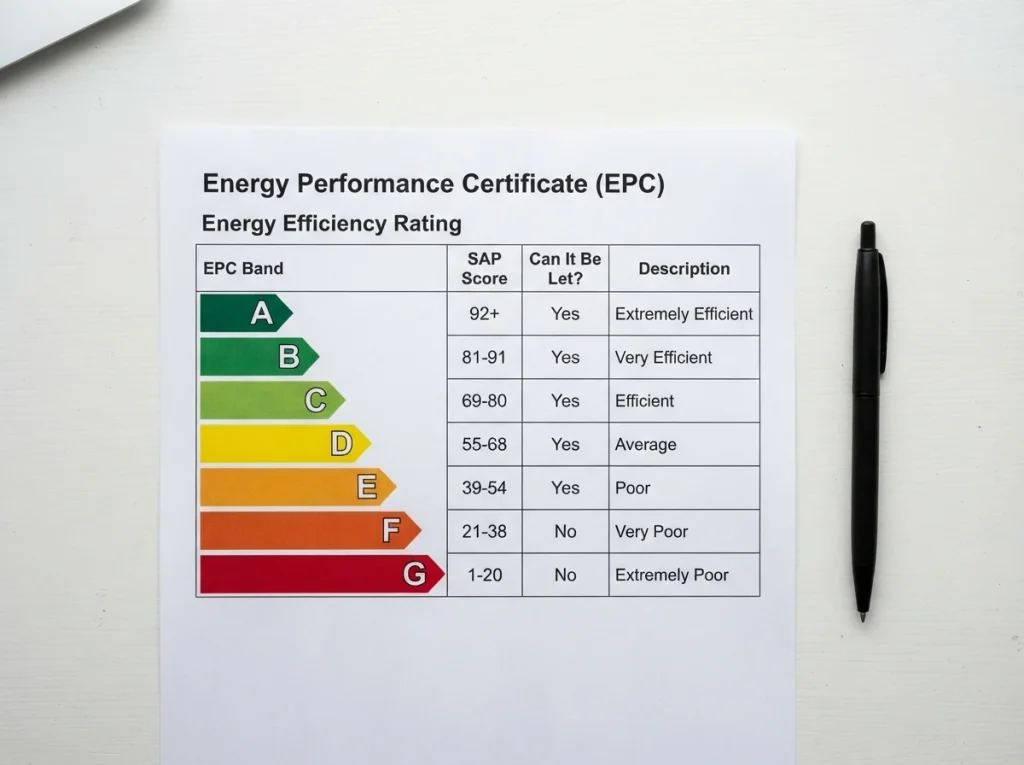
EPC ratings run from A (92 or above) down to G (1 to 20). The table below shows each band’s SAP score range, the kind of property you typically find in it, and what it currently means for letting in England and Wales.
| EPC Band | SAP Score | Typical Property | Can It Be Let Today? |
|---|---|---|---|
| A | 92+ | New build with solar panels, heat pump and very high insulation | Yes |
| B | 81–91 | Most modern new builds | Yes |
| C | 69–80 | Well-insulated home with a modern condensing boiler | Yes |
| D | 55–68 | Typical older home with some upgrades | Yes |
| E | 39–54 | Older home with gaps in insulation or an ageing boiler | Yes (current legal minimum) |
| F | 21–38 | Poorly insulated home, often with inefficient heating | No, unless exempt |
| G | 1–20 | Very poor insulation, expensive or outdated heating | No, unless exempt |
Most homes in England sit in Bands C and D. Bands A and G are both relatively rare, for opposite reasons.
EPC Rating Bands A to G: A Band-by-Band Breakdown
(For Illustration Purposes Only)
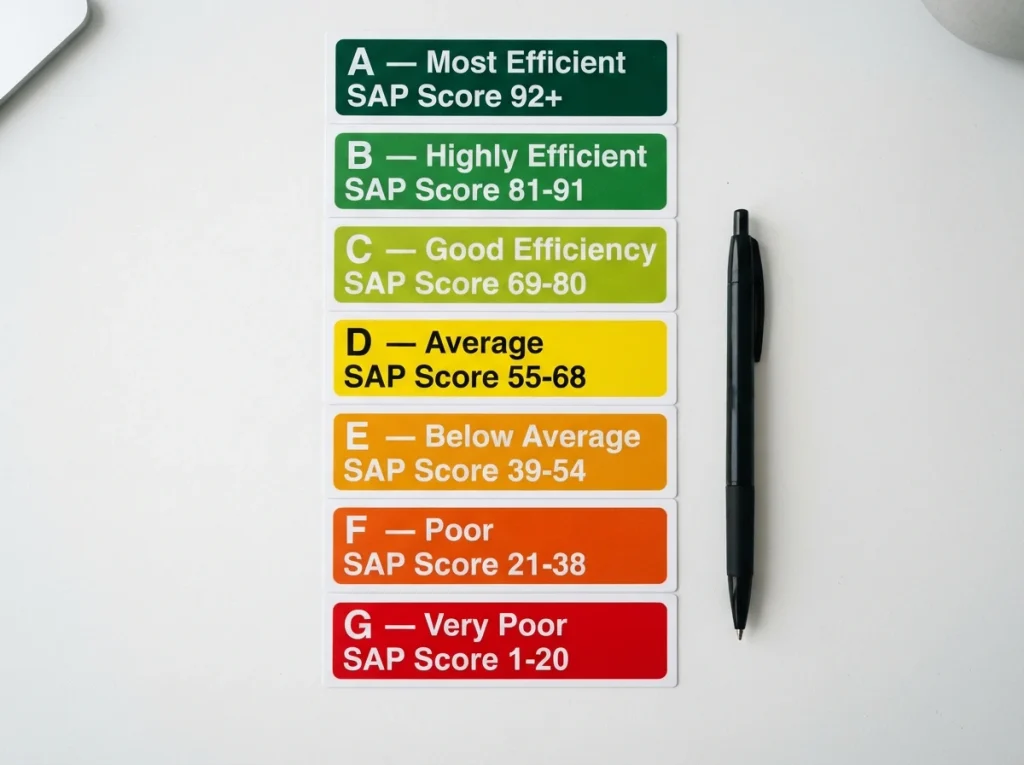
Each EPC band describes a different level of running costs and a different set of likely property features. Here is what the letter on your certificate is really telling you.
EPC Rating A Meaning
An EPC rating of A means the property is among the most energy-efficient homes in the country, with a SAP score of 92 or more. Running costs are very low.
Band A homes usually combine high levels of insulation, airtight construction, triple or high-performance glazing and renewable technology such as solar panels or an air source heat pump. You rarely see Band A in older housing stock.
EPC Rating B Meaning
A Band B rating (81 to 91) means the property is highly efficient. This is where most new builds land, thanks to modern Building Regulations for insulation and heating.
Buyers often see Band B as a sign of low bills, and some lenders offer green mortgage deals for homes in Bands A and B.
EPC Rating C Meaning
EPC rating C means the property is energy efficient by current standards, with a SAP score between 69 and 80. It typically has good loft insulation, filled cavity walls where the construction allows, double glazing and an efficient condensing boiler.
Band C matters for landlords because it is the target level for 2030. A property that reaches C on its current energy efficiency rating before 1 October 2029 will be treated as compliant with the new standard until that EPC expires or is replaced.
EPC Rating D Meaning
A Band D EPC means average energy efficiency, with a SAP score of 55 to 68. The average home in England falls into this band.
A D-rated property usually has some improvements in place, such as partial loft insulation or a reasonably modern boiler, but also clear gaps. It is legal to let today. For landlords, the key question is whether it sits near the top of D, where a few measures could lift it to C, or near the bottom.
EPC Rating E Meaning
EPC rating E means below-average energy efficiency, with a SAP score between 39 and 54. It is the current legal minimum for letting a domestic property in England and Wales under MEES 2018.
An E rating often points to older construction, such as solid brick walls with no wall insulation, single glazing in places, or an older boiler. The rating is legal for now, but an E-rated rental will need meaningful work before the 2030 deadline.
EPC Rating F Meaning
An F rating (21 to 38) means the property is inefficient and expensive to heat. Landlords cannot grant a new tenancy or continue an existing one on an F-rated home unless a valid exemption is registered on the PRS Exemptions Register.
F ratings often come from electric heating without modern controls, little or no insulation, or a combination of both.
EPC Rating G Meaning
EPC rating G is the lowest band, with a SAP score of 1 to 20. It means the property has very poor energy efficiency and very high running costs for its size.
G-rated homes carry the same letting ban as F. In practice, these properties often have no central heating, rely on portable heaters, or have serious gaps in the building fabric.
Current vs Potential EPC Rating: How to Read the Graph
(For Illustration Purposes Only)
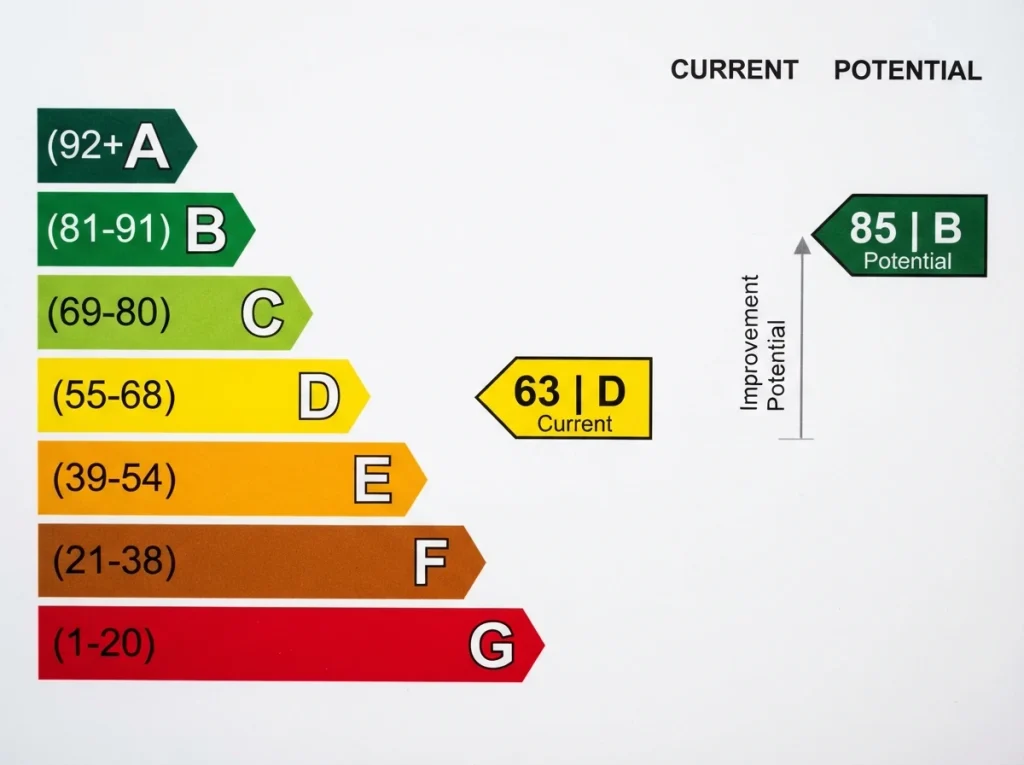
Every EPC shows two ratings on the graph: current and potential. The current rating is what the property achieves today. The potential rating is what it could achieve if you carried out the recommended improvements listed on the certificate.
The gap between the two is useful. A home rated D with a potential of B has clear, identified routes to improvement. A home rated E with a potential of only D has fewer easy wins, which is common with listed buildings and older solid-wall properties.
The recommendations section lists each suggested measure with an indicative cost and the rating you could expect after installing it. Measures appear in a set order, so you can see which improvements the software expects to make the biggest difference first.
How to raise an EPC rating is a large topic in its own right. In short, the cheapest gains usually come from insulation and heating controls, while the biggest jumps tend to come from heating system upgrades and renewables.
What Decides Your EPC Band?

(For Illustration Purposes Only)
Your EPC band depends mainly on how well the building holds heat and how efficiently it produces heat and hot water. The property’s age, construction type and fuel source all shape the final score.
| Factor | What the Assessor Records | Effect on Your Rating |
|---|---|---|
| Walls | Construction type and any cavity or solid wall insulation | High |
| Roof | Loft insulation depth or roof insulation | High |
| Heating system | Boiler type, age and efficiency, or other heat source | Very high |
| Heating controls | Programmer, room thermostat, TRVs | Medium |
| Windows | Single, double or triple glazing | Medium |
| Hot water | Cylinder insulation, combi boiler, immersion heater | Medium |
| Floors | Floor insulation where evidence exists | Low to medium |
| Lighting | Proportion of low-energy lighting | Low |
| Renewables | Solar panels, heat pumps, solar water heating | High |
Why Evidence Matters During the Assessment
A DEA can only record what they can see or what you can prove. If your cavity walls were filled ten years ago but there is no visible drill pattern and no paperwork, the assessor may have to use default assumptions based on the property’s age.
Keep guarantees, installation certificates and invoices for insulation, boilers and glazing. Having them to hand on the day can make the difference between two bands.
What EPC Ratings Don’t Tell You
An EPC rating does not show your actual energy bills, the condition of the property, or how the current occupants use energy. It is a standardised model, not a meter reading.
The SAP calculation assumes a typical household, with standard heating patterns and occupancy. A single person who works away all week and a family of five at home all day would get the same rating in the same house, even though their bills would look nothing alike.
Why Your EPC Rating Can Change Without Any Work
Landlords are sometimes surprised when a new EPC shows a different band, even though nothing has changed in the property. There are three common reasons.
First, the calculation method gets updated. The move to RdSAP 10 in 2025 changed how some features are assessed. Second, the underlying fuel prices and assumptions used in the software change over time.
Third, a different assessor may find evidence the previous one could not, or may not find evidence the previous one relied on. This is why the SAP number matters. A property sitting on a band boundary can move either way.
The Reformed EPC Is Coming
Energy Performance Certificates are being reformed. The government plans to replace the single rating with several metrics, including fabric performance, heating system and smart readiness, based on the new Home Energy Model. The existing energy efficiency rating will remain on certificates during the transition.
What Your EPC Rating Means If You Let Property
(For Illustration Purposes Only)
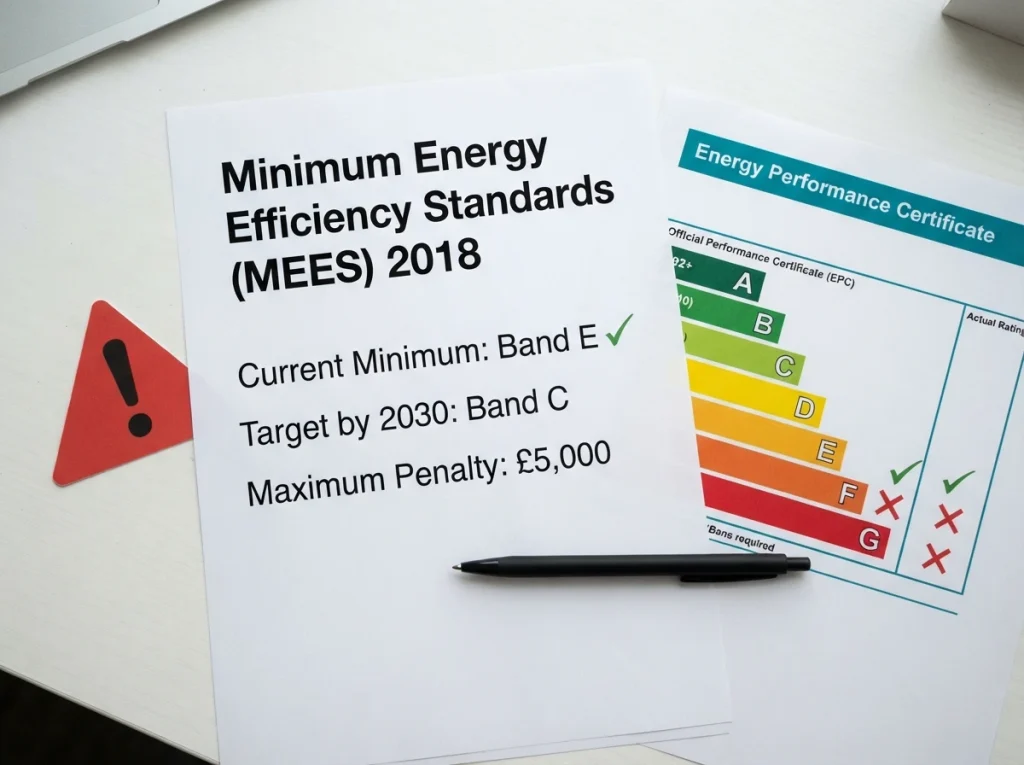
If you let property in England or Wales, your EPC rating decides whether you can legally let it. Under the Energy Performance of Buildings Regulations 2012, you must have a valid EPC, and under MEES 2018, that EPC must show Band E or above.
| Rule | Detail |
|---|---|
| EPC required for letting | Yes, under the Energy Performance of Buildings Regulations 2012 |
| Current minimum band | E |
| F or G rated | Cannot be let without a registered exemption |
| Maximum penalty | Up to £5,000 per property |
| Enforcement | Local authority trading standards or housing teams |
| EPC validity | 10 years |
| 2030 target | Band C equivalent by 1 October 2030 |
Council enforcement has picked up in recent years, and London boroughs are among the more active in checking the EPC register against known rental addresses. Letting agents will also usually refuse to market a property without a valid certificate in place.
If your rental is currently D or E, now is a sensible time to look at the potential rating on your certificate. That tells you roughly how far you are from Band C and which measures the assessor expects to get you there.
The Bottom Line on EPC Ratings
In short, EPC ratings work on three levels. The letter tells you how efficient a property is, the SAP number tells you exactly where it sits within that band, and the potential rating tells you where it could get to.
For homeowners, the rating shapes energy bills, resale appeal and access to some green mortgage deals. For landlords, it decides whether a property can be let at all, both today under MEES 2018 and after the 2030 Band C deadline.
Reading the whole certificate, not just the coloured arrow, gives you a far clearer picture. Check the SAP score, compare it with the potential rating and keep evidence of every improvement for the next assessment.
Book an EPC Assessment With EICR Landlord Cert
EICR Landlord Cert Ltd carries out domestic EPC assessments for landlords, letting agents and homeowners across all 32 London boroughs from our base on City Road, EC1V. Our Elmhurst Energy accredited assessors are DBS checked and covered by public liability insurance, and we lodge every certificate on the government EPC register. EPCs start from £89, and same-day assessments are often available. Call 0203 633 9146, Monday to Friday, 9:00 AM to 6:00 PM, to book.
Frequently Asked Questions
What is an EPC rating?
An EPC rating is a grade from A to G that shows how energy efficient a property is. It is based on a SAP score from 1 to 100+, calculated by an accredited Domestic Energy Assessor using details of the property’s insulation, heating, glazing, hot water and lighting.
Band A (92+) is the most efficient and cheapest to run. Band G (1 to 20) is the least efficient. The rating appears on the Energy Performance Certificate, which is valid for 10 years.
What does EPC rating C mean?
EPC rating C means a property is energy efficient by current standards, with a SAP score between 69 and 80. A Band C home usually has good loft insulation, insulated walls where possible, double glazing and an efficient condensing boiler.
Band C is also the target standard for privately rented homes in England and Wales, which must reach a Band C equivalent by 1 October 2030 under the confirmed changes to the Minimum Energy Efficiency Standards.
Is an EPC rating of D good?
An EPC rating of D is average rather than good or bad, covering SAP scores from 55 to 68, and the typical home in England sits in this band. A D-rated property can be legally let today because it is above the Band E minimum.
However, landlords will need to lift D-rated rentals to a Band C equivalent by 1 October 2030, so it is worth checking how close your SAP score is to 69.
What EPC rating do you need to rent a property?
Under the Minimum Energy Efficiency Standards (MEES) 2018, you currently need an EPC rating of E or above to rent out a domestic property in England and Wales.
Properties rated F or G cannot be let on new or existing tenancies unless the landlord registers a valid exemption on the PRS Exemptions Register. Breaches can lead to fines of up to £5,000 per property, enforced by the local authority.
What happens if my EPC is Band F or G?
If your EPC is Band F or G, you cannot legally let the property until you either improve it to at least Band E or register a valid exemption. Exemptions cover situations such as all relevant improvements having been made up to the cost cap or third-party consent being refused.
Letting an F or G property without an exemption can result in penalties of up to £5,000 and publication of the breach on the PRS Exemptions Register.
How long does an EPC last?
An EPC lasts for 10 years from the date it is lodged on the government register, and you can use the same certificate for any number of sales or lettings during that period.
However, if you have made improvements such as new insulation or a new boiler, getting a fresh EPC before the old one expires can show a better rating. Landlords must have a valid EPC in place before marketing a property to let.
How can I improve my EPC rating?
You can improve your EPC rating by reducing heat loss and upgrading how the property is heated. Common measures include topping up loft insulation, filling cavity walls, upgrading to an efficient condensing boiler, adding heating controls and TRVs, fitting double glazing and switching to low-energy lighting.
Renewables such as solar panels can give larger jumps, and your certificate lists recommended improvements in order, along with the rating you could expect after each one.
How long does an EPC assessment take?
An EPC assessment for a typical flat or house takes between 30 and 60 minutes. Larger or more complex properties can take longer. The assessor measures the rooms, photographs key features and records the heating system, insulation, glazing and lighting.
The certificate is then produced and lodged on the EPC register. To book an EPC with an Elmhurst Energy accredited assessor, call EICR Landlord Cert on 0203 633 9146.