
An EPC certificate, or Energy Performance Certificate, is an official document that rates how energy efficient a building is on a scale from A (most efficient) to G (least efficient). You legally need one when a property is built, sold or rented, and each certificate stays valid for 10 years.
Thousands of rental homes in England and Wales still sit in Bands F and G. Under current law, a landlord cannot legally let most of those properties without a registered exemption, and the fine for getting it wrong can reach up to £5,000 per property.
The rules come from the Energy Performance of Buildings Regulations 2012 and the Minimum Energy Efficiency Standards, known as MEES 2018. Together, they decide when you need an EPC, who can produce one, and what rating a rental home must reach.
Most people only think about their EPC when an estate agent or letting agent asks for it. By then, a poor rating can delay a sale or stop a tenancy from starting.
This guide covers what EPC stands for, what the certificate shows, how the A to G ratings work, what happens during an EPC check, and the legal rules every landlord should know. You’ll also find answers to the questions homeowners and landlords ask us most often.
What Does EPC Stand For?
(For Illustration Purposes Only)
EPC stands for Energy Performance Certificate. It is a standardised report that measures a building’s energy use and carbon emissions, then gives it an energy efficiency rating from A to G, along with practical recommendations for improvement.
The EPC meaning is the same whether you own a flat, a house or a commercial unit. Only the assessment method changes.
EPC Meaning in Property vs Cars
If you searched “EPC meaning” and found car forums, you’re not alone. In Volkswagen, Audi and SEAT vehicles, EPC means Electronic Power Control, a dashboard warning light for engine and throttle faults.
It has nothing to do with property. In housing, estate agency and lettings, EPC always refers to the Energy Performance Certificate.
The EPC at a Glance
| Detail | What You Need to Know |
|---|---|
| Full name | Energy Performance Certificate |
| Main legislation | Energy Performance of Buildings Regulations 2012 |
| Rental standard | Minimum Energy Efficiency Standards (MEES) 2018 |
| Rating scale | Band A (92 to 100) down to Band G (1 to 20) |
| Validity | 10 years |
| Who produces it | An accredited Domestic Energy Assessor (DEA) or Non-Domestic Energy Assessor |
| Where it’s stored | The government EPC Register |
| Minimum band to rent | Band E |
| Maximum MEES penalty | Up to £5,000 per property |
What Is an EPC Certificate Used For?

(For Illustration Purposes Only)
An EPC certificate tells buyers and tenants how much a property is likely to cost to heat and power, and how it compares with similar homes. It also gives the government a way to enforce minimum energy standards in the private rented sector.
The requirement traces back to the EU Energy Performance of Buildings Directive (EPBD). The UK wrote it into domestic law, and it still applies today.
When You Need an EPC
| Situation | EPC Required? | Who Is Responsible |
|---|---|---|
| Selling a home | Yes, before marketing | Seller or estate agent |
| Renting a home | Yes, before viewings | Landlord or letting agent |
| New build property | Yes, on completion | Developer or builder |
| Commercial property sale or let | Yes (commercial EPC) | Owner or landlord |
| Large public buildings | Display Energy Certificate (DEC) | Occupying public authority |
| Most listed buildings | Often yes, with limited exceptions | Owner |
You must be able to show a valid certificate from the point you start marketing the property. Adverts on property portals usually display the rating graph, which is why agents ask for it on day one.
Who Does Not Need an EPC
A small number of buildings are exempt. These include places of worship, temporary buildings used for less than two years, standalone buildings under 50 square metres that are not dwellings, and some buildings due for demolition.
Listed buildings sit in a grey area. You may not need one if meeting the energy standards would unacceptably alter the building’s character, but many listed homes still require an EPC in practice.
What Does an EPC Show?
(For Illustration Purposes Only)
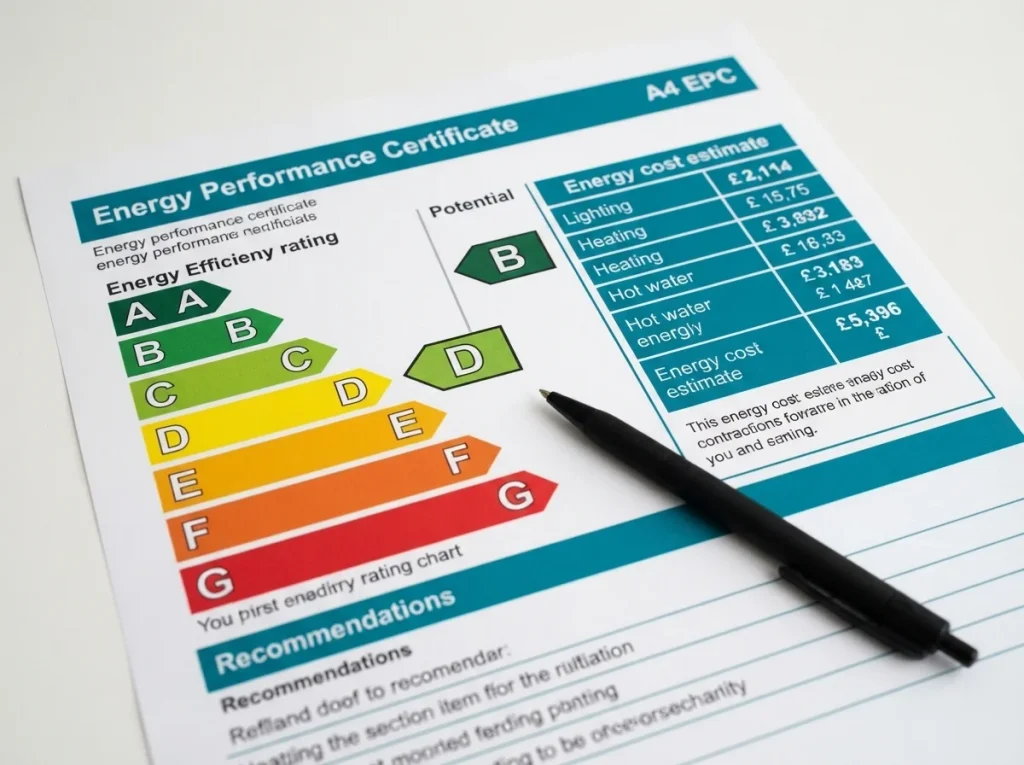
An EPC shows the property’s current energy efficiency rating, its potential rating after recommended improvements, estimated energy costs, and a list of measures that could lower bills. Each certificate also carries a unique report reference number linked to the EPC Register.
Current and Potential Rating
The coloured A to G graph is the part everyone recognises. The left arrow shows the current rating, and the right arrow shows the potential rating if you carry out every recommended improvement.
A gap of two or more bands usually means there are affordable upgrades available.
Estimated Energy Costs
This section estimates how much heating, hot water and lighting would cost over a set period. The figures assume typical occupancy, so a tenant’s actual bills may be higher or lower.
Recommendations Report
The recommendations list upgrades in order of cost and impact. Common examples include:
- Loft insulation topped up to 270mm
- Cavity wall insulation
- Solid wall insulation for older properties
- Double glazing or secondary glazing
- A more efficient condensing boiler
- Heating controls such as room thermostats and TRVs
- Low-energy lighting throughout
- Solar panels or other renewable energy systems
Each recommendation shows the rating the property could reach once completed.
Environmental Impact Rating
Alongside the energy rating, the EPC gives an environmental impact (CO2) rating. This measures the property’s carbon emissions on the same A to G scale.
What Is an EPC Rating? Bands A to G Explained
(For Illustration Purposes Only)
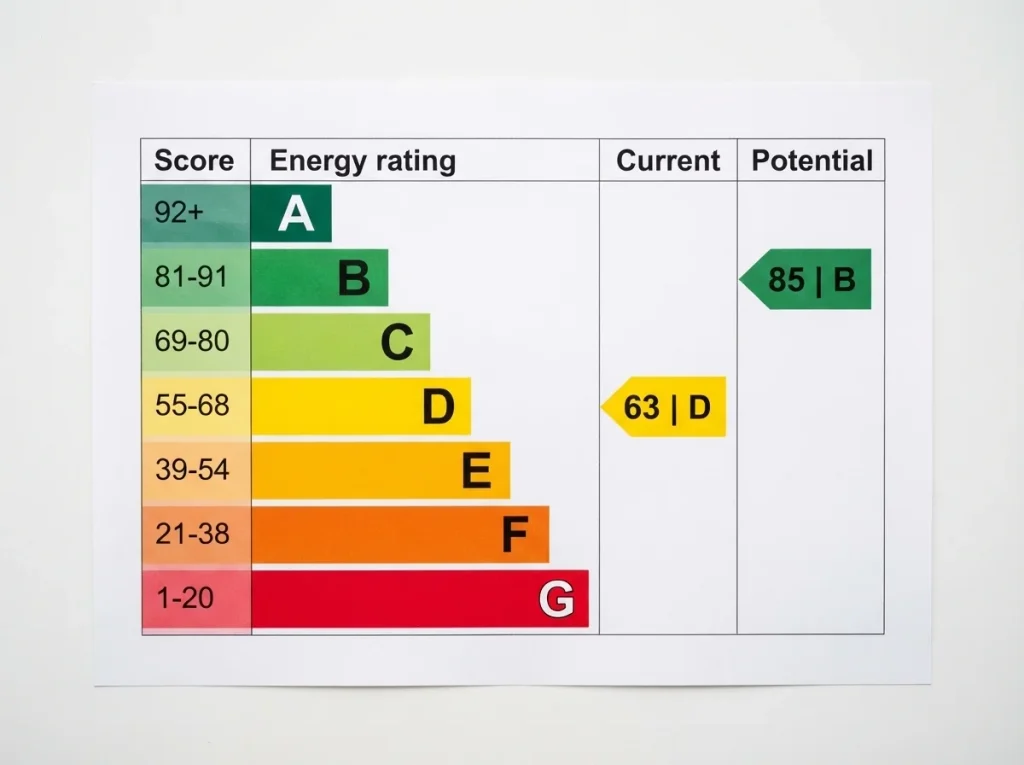
An EPC rating is a letter from A to G based on a numerical SAP score between 1 and 100+. The higher the score, the cheaper the property is to run and the lower its carbon emissions. The average home in England and Wales currently sits in Band D.
| EPC Band | SAP Score | What It Typically Means |
|---|---|---|
| A | 92 to 100+ | Very efficient, often new builds with solar panels |
| B | 81 to 91 | Modern, well-insulated homes |
| C | 69 to 80 | Good efficiency, the future rental target |
| D | 55 to 68 | Average for existing housing |
| E | 39 to 54 | Below average, the current legal minimum to rent |
| F | 21 to 38 | Poor, cannot be let without an exemption |
| G | 1 to 20 | Very poor, cannot be let without an exemption |
The software calculates the SAP score from the building’s fabric, heating system, hot water, ventilation and lighting. It rates the property, not the people living in it, so a frugal household doesn’t improve the score.
Victorian terraces with solid walls often land in Band D or E. That’s a common pattern in older London stock, where many rental flats sit in converted period houses with single glazing and no wall insulation.
What Is an EPC Check? How the Assessment Works
An EPC check is a non-invasive visual survey carried out by an accredited energy assessor. The assessor records the property’s construction, insulation, heating and lighting, then feeds the data into government-approved software that calculates the rating. Most homes take 30 to 60 minutes.
Nothing gets drilled, lifted or damaged. The assessor simply looks, measures and photographs.
During the visit, the assessor also notes the property’s age, floor area, glazing and any renewable technology. Having boiler paperwork and insulation certificates to hand can lift the rating, because the software applies less favourable default assumptions to anything the assessor can’t verify. Existing homes are assessed using RdSAP, while new builds use full SAP and commercial buildings use SBEM.
Who Can Carry Out an EPC?
Only an accredited Domestic Energy Assessor can produce a domestic EPC. Assessors must belong to a government-approved accreditation scheme such as Elmhurst Energy, Stroma Certification or Quidos, which audit their work and lodge certificates on the national register.
EPC Rules for Landlords
(For Illustration Purposes Only)
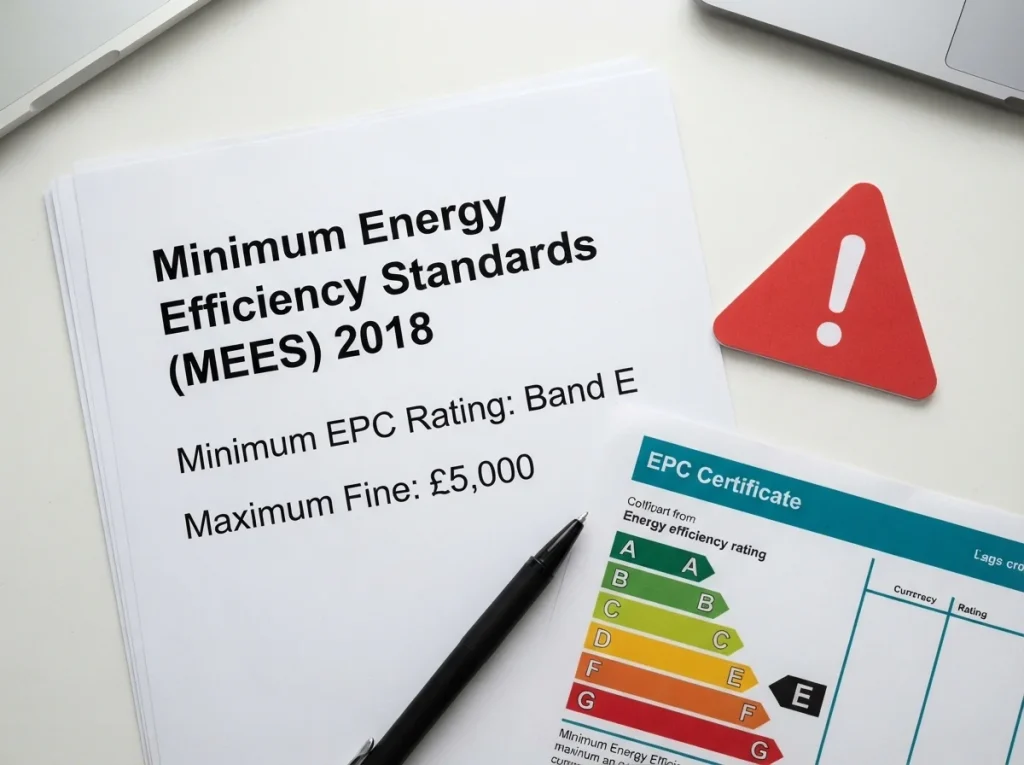
Landlords in England and Wales must have a valid EPC rated Band E or above before letting a property, and must give a copy to tenants free of charge. These rules sit under the Energy Performance of Buildings Regulations 2012 and the Minimum Energy Efficiency Standards (MEES) 2018.
MEES has applied to new tenancies since 1 April 2018 and to all existing tenancies since 1 April 2020.
EPC Penalties for Landlords
| Breach | Maximum Penalty | Legislation |
|---|---|---|
| Letting a Band F or G property without a registered exemption | Up to £5,000 per property | MEES 2018 |
| Failing to provide an EPC to a prospective tenant | £200 per dwelling | Energy Performance of Buildings Regulations 2012 |
Local authority trading standards teams enforce these rules. They can also publish details of the breach on a public register, which can affect your reputation with letting agents.
EPC Exemptions
If you can’t reach Band E, you may qualify for an exemption. The most common is the high-cost exemption, which applies when you’ve spent the £3,500 cap on improvements and the property still falls short. Exemptions must be registered on the PRS Exemptions Register and generally last five years.
Upcoming Changes: Band C by 2030
The standard is rising. The government has confirmed that rental properties in England and Wales will need to reach the equivalent of EPC Band C by 1 October 2030, with a higher cost cap of £10,000. If your property currently sits in Band D or E, it’s worth planning upgrades now rather than in 2029.
How to Find an Existing EPC
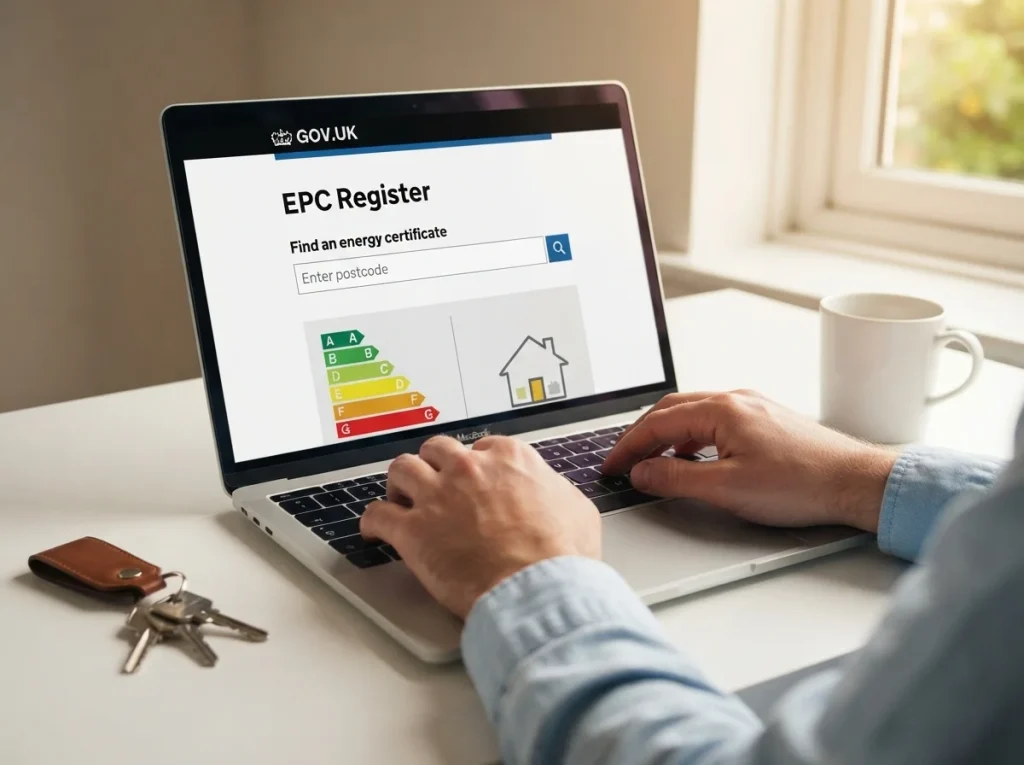
(For Illustration Purposes Only)
You can find any lodged EPC for free on the government EPC Register by searching the property’s postcode or address. The register, run by MHCLG, shows the rating, the assessment date, the expiry date and the full recommendations report.
This is useful before you buy a property, sign a tenancy or commission a new assessment. If a valid EPC already exists, you don’t need a new one. Check the expiry date carefully, because a certificate that expires during a tenancy will need replacing before the next new let.
Every EPC on the register is public. Anyone can view your property’s rating, which is worth remembering if you’re preparing to sell or let.
Common EPC Myths Worth Clearing Up
An EPC is not a pass or fail test, a safety inspection, or something you need every time a tenancy renews. Many landlords overspend or fall foul of the rules because of these misunderstandings.
Here are the ones we hear most often:
- “My EPC failed.” EPCs don’t pass or fail. A rating below Band E simply means you can’t legally let the property without improvements or an exemption.
- “I need a new EPC for every new tenant.” You don’t. A valid certificate covers any number of tenancies within its 10-year life.
- “An expired EPC ends my tenancy.” An EPC expiring during an existing tenancy doesn’t automatically put you in breach. You’ll need a valid one before the next new let or renewal.
- “The EPC checks my boiler is safe.” It doesn’t. The assessor looks at efficiency, not safety, so you’ll still need separate safety checks.
- “A new EPC always gives the same rating.” Assessment software and conventions change, so a re-assessment can move the rating up or down, even with no changes to the home.
The Bottom Line on EPC Certificates
(For Illustration Purposes Only)
So, what is an EPC certificate? It’s a 10-year document that rates a building’s energy efficiency from A to G, lists practical improvements, and determines whether a rental property can legally be let. For landlords, it’s a legal requirement with real financial consequences.
Checking your rating early gives you time to act. If the property sits in Band F or G, you’ll need improvements or a registered exemption before the next let, and even a Band D or E rating deserves a closer look.
With the Band C deadline set for October 2030, your current EPC rating is also the starting point for planning the next few years of upgrades. Acting now spreads the cost and avoids a rush on contractors as the deadline approaches.
Book an EPC Assessment with EICR Landlord Cert
EICR Landlord Cert provides domestic EPC assessments for landlords, letting agents, homeowners and property managers across all 32 London boroughs. Our Elmhurst Energy accredited assessors are DBS checked and covered by public liability insurance, and EPC assessments start from £89, with same-day assessments often available. We’re based at 128 City Road, London, EC1V 2NX, and you can book by calling 0203 633 9146, Monday to Friday, 9:00 AM to 6:00 PM.
Frequently Asked Questions
What is an EPC certificate?
An EPC certificate, or Energy Performance Certificate, is an official document that rates a building’s energy efficiency from Band A (most efficient) to Band G (least efficient). It shows estimated energy costs, a potential rating and recommended improvements.
An accredited energy assessor produces it after a short visual survey, and the certificate is lodged on the government EPC Register. It’s legally required when a property is built, sold or rented in England and Wales, and it remains valid for 10 years.
Is an EPC mandatory for landlords in the UK?
Yes. Landlords in England and Wales must have a valid EPC before marketing a property to rent and must provide a free copy to tenants. The property must also meet Band E or above under the Minimum Energy Efficiency Standards (MEES) 2018, unless a valid exemption is registered.
Letting a Band F or G property without an exemption can lead to a fine of up to £5,000 per property. Scotland and Northern Ireland have their own separate EPC rules.
How long does an EPC last?
An EPC lasts for 10 years from the date it’s lodged on the EPC Register. You can use the same certificate for multiple sales or tenancies during that period, as long as it remains valid. You don’t need a new EPC just because a tenant changes.
However, if you’ve made major improvements such as new insulation or a new boiler, commissioning a fresh assessment can reflect the better rating and improve how the property appears to buyers and tenants.
What EPC rating do you need to rent a property?
A privately rented property in England and Wales currently needs an EPC rating of Band E or above. This minimum has applied to all tenancies since 1 April 2020 under the Minimum Energy Efficiency Standards (MEES) 2018.
Properties rated Band F or G can only be let if the landlord has registered a valid exemption on the PRS Exemptions Register. The government has confirmed the minimum will rise to the equivalent of Band C by 1 October 2030 for all tenancies.
Can you rent a property without an EPC?
No. You cannot legally market or let a property in England and Wales without a valid EPC, apart from a small number of exempt building types. Landlords who fail to provide an EPC to prospective tenants can receive a £200 penalty per dwelling under the Energy Performance of Buildings Regulations 2012.
Without a valid EPC, you also have no evidence that the property meets the Band E minimum, which exposes you to MEES penalties of up to £5,000 per property.
What is checked in an EPC assessment?
An energy assessor checks the property’s age, construction, floor area, wall type, loft insulation, windows and glazing, boiler and heating controls, hot water system, lighting and any renewable technology such as solar panels. The survey is visual and non-invasive, so nothing is drilled or damaged.
The assessor enters the data into approved RdSAP software, which calculates the SAP score and EPC rating. Providing documents for hidden features, like cavity wall insulation, can improve the result.
How long does an EPC assessment take?
Most EPC assessments for a typical flat or house take between 30 and 60 minutes. Larger homes, properties with extensions, or buildings with complex heating systems can take longer. The assessor needs access to every room, the loft and the boiler.
Once the survey is done, the assessor processes the data and lodges the certificate on the EPC Register. To book an assessment with an accredited assessor, call EICR Landlord Cert on 0203 633 9146.
What happens if my EPC is Band F or G?
If your EPC is Band F or G, you cannot grant a new tenancy or continue letting the property unless you improve it to Band E or register a valid exemption. Typical upgrades include loft insulation, cavity wall insulation, heating controls and a more efficient boiler.
If you spend £3,500 on eligible improvements and still can’t reach Band E, you can apply for a high-cost exemption, which generally lasts five years once registered.
How do I find my EPC certificate online?
You can find your EPC certificate online by searching the government EPC Register using your postcode or address. The service is free and shows the energy rating, assessment date, expiry date and full recommendations report.
You can download or print the certificate directly from the register. If no certificate appears, or the existing one has expired, you’ll need to book a new assessment with an accredited Domestic Energy Assessor.