
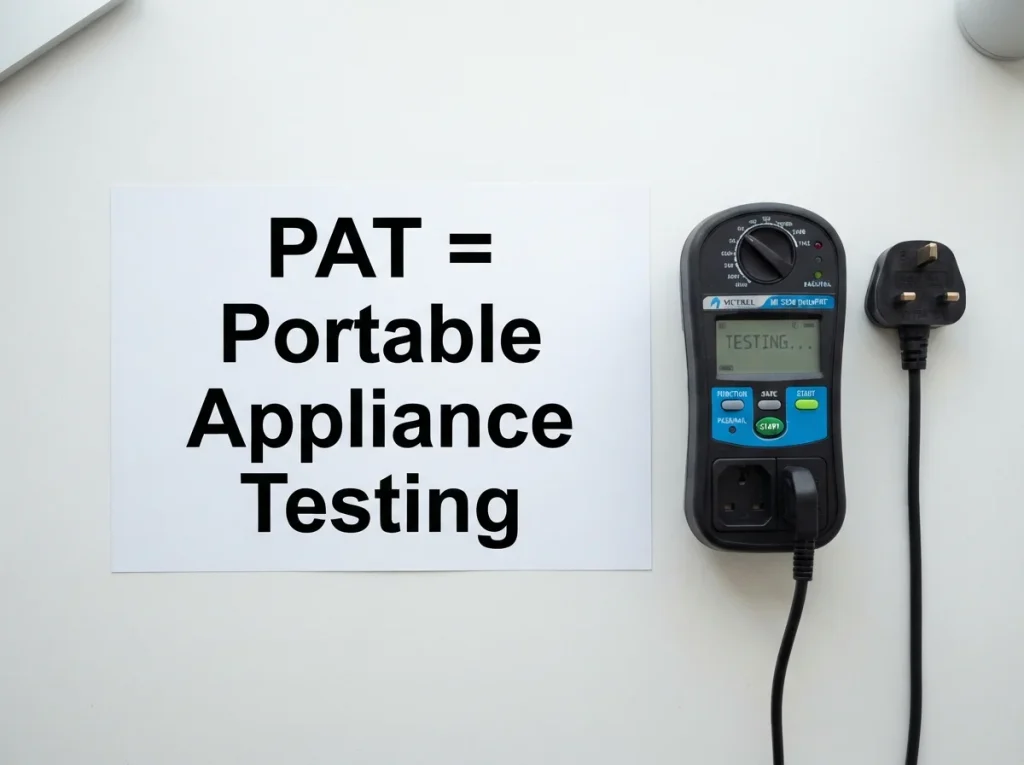
PAT Testing, short for portable appliance testing, is a safety check on electrical items that plug into a socket. A qualified tester inspects each appliance, runs electrical tests on its earth, insulation and wiring, then labels it pass or fail. You get a dated record showing every item was safe when checked.
That record matters more than most landlords expect. A kettle with a nicked flex or a fridge left behind by the last tenant can sit in a rental for years before anyone notices. When it finally fails, the first question is who supplied it, and the answer is often you.
In England and Wales, no single law says “landlords must PAT test”. However, the Electrical Equipment (Safety) Regulations 2016, the Consumer Protection Act 1987 and the Housing Act 2004 all require the appliances you supply to be safe. PAT Testing is the simplest way to prove you’ve met that duty.
For HMO landlords, the stakes are higher. Many councils write PAT Testing directly into HMO licence conditions, and breaching a licence condition can lead to a civil penalty of up to £30,000.
This guide covers what PAT Testing means, what a PAT test actually checks, how appliance classes change the test, which items in a rental need testing, and where the legal lines sit. You’ll also find what happens on the day, what pass and fail labels mean, and answers to the questions landlords ask us most.
What Does PAT Testing Mean?
(For Illustration Purposes Only)
PAT Testing means the routine inspection and testing of electrical equipment to confirm it’s safe to use. The industry’s formal term is “in-service inspection and testing of electrical equipment”, which comes from the IET Code of Practice that testers follow. “PAT” simply stands for Portable Appliance Testing.
The name is slightly misleading. A PAT test covers far more than things you can carry around. Any electrical item connected to the mains by a plug and flex falls within scope, including a washing machine that never moves from under the worktop.
What Counts as a Portable Appliance?
The IET Code of Practice groups equipment by how it’s used rather than how heavy it is. In a rental property, you’ll usually find:
- Portable appliances: kettles, toasters, fans, table lamps and heaters that are easy to move while switched off
- Hand-held appliances: hairdryers, irons and vacuum cleaners held during use
- Stationary appliances: fridges, freezers, washing machines and tumble dryers that are heavy but still plug in
- IT equipment: televisions, monitors, printers and routers supplied with the property
- Extension leads and adaptors: often the most neglected items in any let
What PAT Testing Doesn’t Cover
PAT Testing checks the appliance and its lead, not the building. Fixed wiring, sockets, light fittings and the consumer unit are checked separately through an EICR.
What Does PAT Testing Test?
(For Illustration Purposes Only)
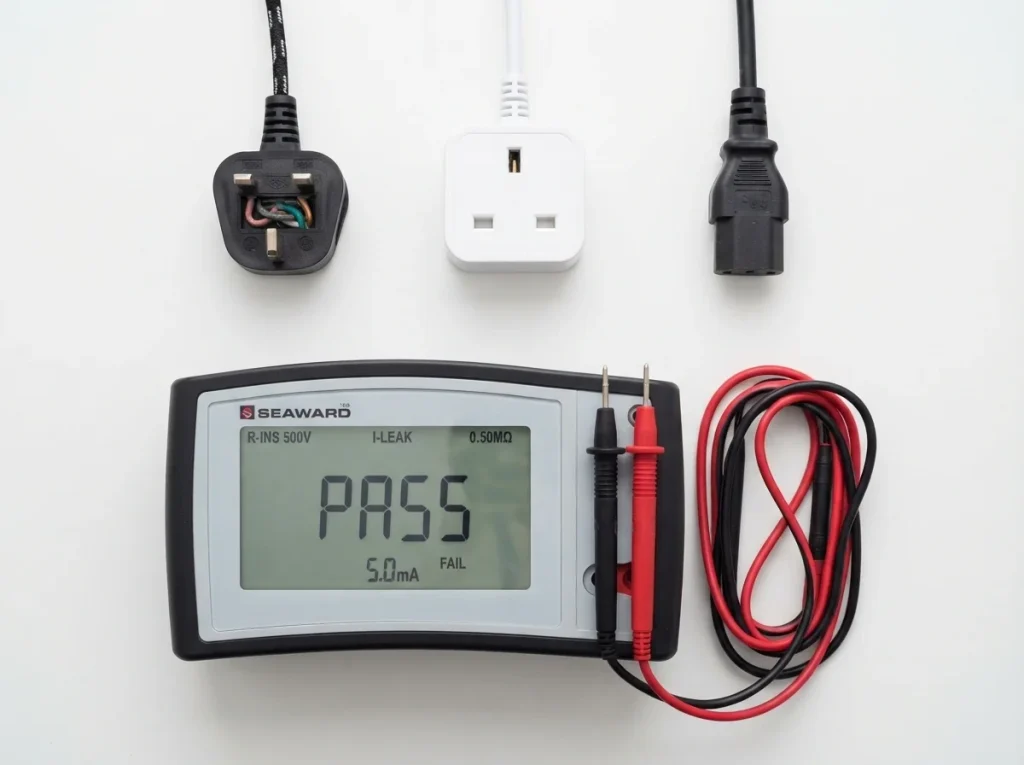
A PAT test checks three things: the physical condition of the appliance, the integrity of its earth connection, and whether its insulation stops current escaping to the user. The exact tests depend on the appliance’s construction, but most items go through a visual inspection followed by a series of electrical measurements.
| Test Stage | What It Checks | Which Appliances |
|---|---|---|
| Visual inspection | Damage to the casing, cable, plug and fuse | All appliances |
| Earth continuity test | The earth wire connects properly from plug to casing | Class I only |
| Insulation resistance test | Insulation prevents current leaking to exposed metal | Class I and Class II |
| Protective conductor or touch current test | How much current leaks while the appliance runs | Class I and Class II, where suitable |
| Polarity test | Live and neutral are wired the right way round | Extension leads and detachable power cords |
| Functional check | The appliance switches on and works as intended | All appliances |
The Visual Inspection
(For Illustration Purposes Only)
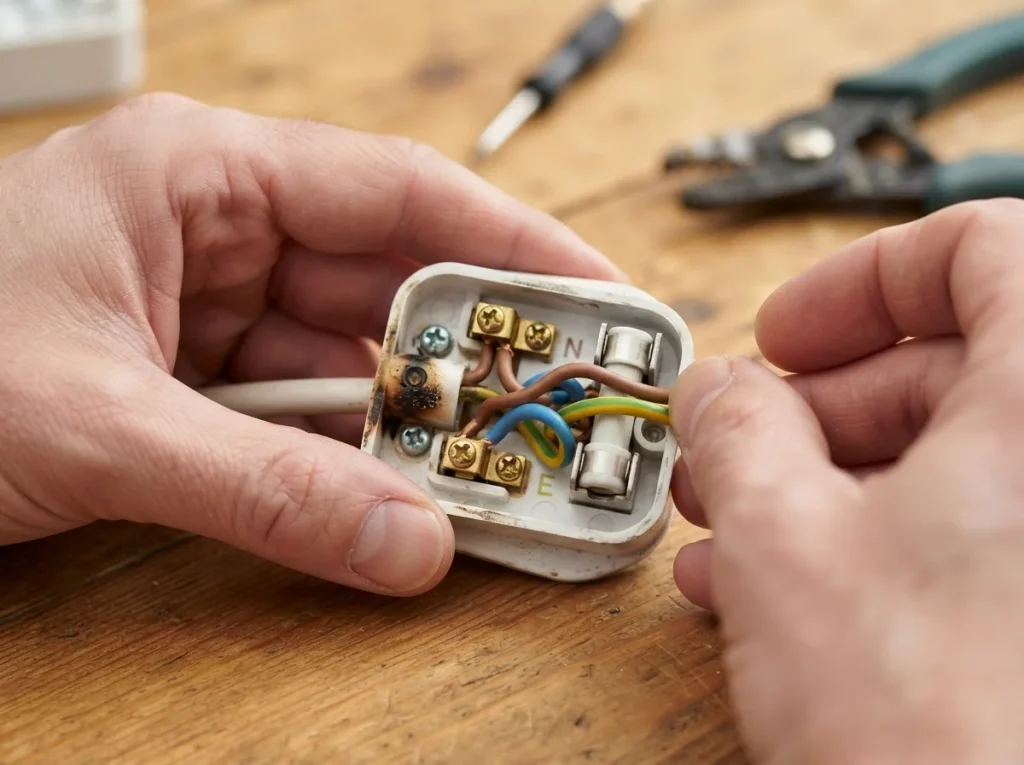
The visual check is where most faults turn up. HSE guidance for low-risk environments points out that many dangerous defects can be spotted simply by looking before any equipment comes out of the bag.
The tester examines the whole appliance and opens the plug to check for:
- Frayed cable, cuts or taped-up repairs
- A cable grip that holds the outer sheath, not the inner wires
- Scorch marks, cracks or signs of overheating
- A fuse of the correct rating (a 13A fuse in a lamp that should have 3A is a common find)
- Loose screws, missing covers or bent pins
The Electrical Tests
(For Illustration Purposes Only)
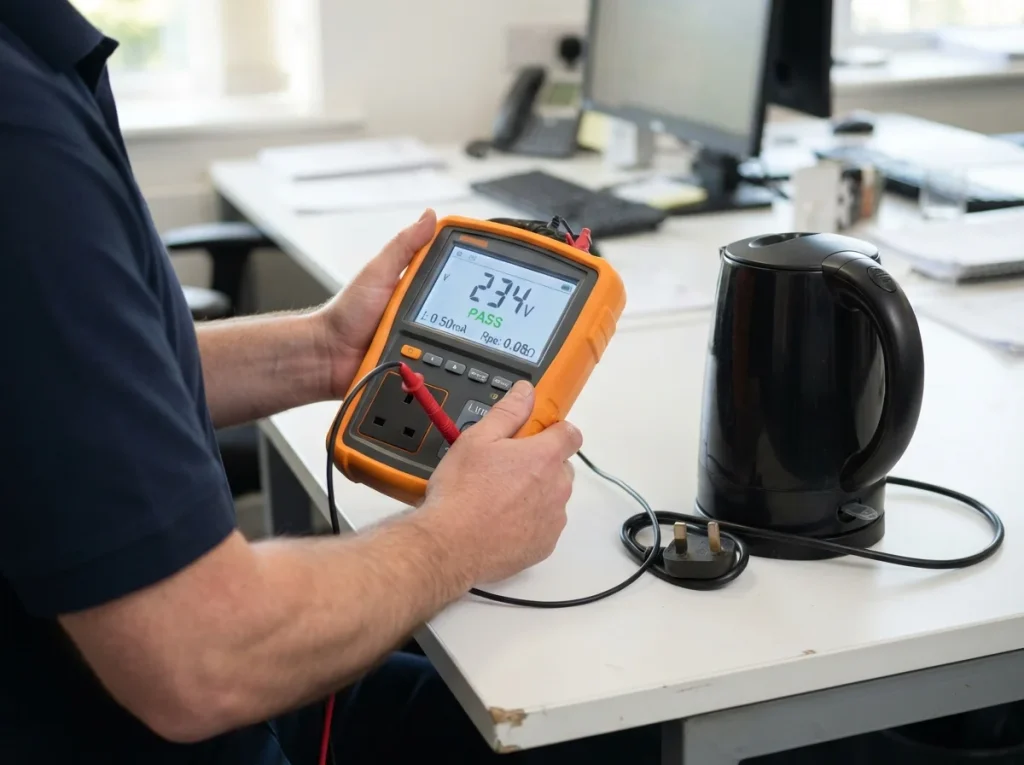
Next, the tester connects the appliance to a calibrated PAT tester. The earth continuity test passes a current through the earth path and measures resistance, which should be no higher than 0.1 ohms plus the resistance of the cable itself.
The insulation resistance test applies 500V DC between the live parts and the casing. Under the IET Code of Practice, a Class I appliance needs at least 1 megohm and a Class II appliance at least 2 megohms to pass.
Appliance Classes and the Tests They Need
Every appliance belongs to a construction class, and that class decides which tests apply. Class I appliances such as kettles and toasters rely on an earth connection, so they get an earth continuity test, while Class II appliances such as hairdryers and lamps rely on double insulation and carry a square-within-a-square symbol. Class III items run at extra-low voltage from a separate charger, and the charger itself is tested as Class II.
Which Appliances Need PAT Testing in a Rental Property?
Any electrical appliance you supply as part of the tenancy should be tested. Items your tenants bring with them are their own responsibility, not yours.
The grey areas cause the most trouble, so here’s how responsibility usually falls:
| Situation | Who Is Responsible |
|---|---|
| Appliances listed in your inventory | Landlord |
| White goods in an unfurnished let | Landlord |
| Items left behind by a previous tenant | Landlord, once you choose to leave them in the property |
| Appliances in HMO communal kitchens and lounges | Landlord or managing agent |
| Tenant’s own TV, laptop or kettle | Tenant |
Abandoned appliances are the trap. If a former tenant leaves a microwave and you let the next tenant keep using it, you’ve effectively supplied it. Either test it or remove it before the new tenancy starts.
A practical habit that saves arguments later: attach your PAT test report to the check-in inventory. If an appliance fails mid-tenancy, you can show it was safe when handed over, which helps in any deposit or liability dispute.
Is PAT Testing a Legal Requirement?
For most single-household lets in England and Wales, PAT Testing isn’t a named legal requirement, but the Electrical Equipment (Safety) Regulations 2016, the Consumer Protection Act 1987, the Landlord and Tenant Act 1985 and the Housing Act 2004 all require supplied appliances to be safe.
Where a property is also a workplace, the Electricity at Work Regulations 1989 and the Health and Safety at Work Act 1974 apply too. In practice, PAT Testing most often becomes mandatory through HMO licence conditions, and in Scotland, government guidance requires landlord-supplied appliances to be tested at least every five years.
How Often Is PAT Testing Needed and What Does It Cost?

(For Illustration Purposes Only)
There’s no fixed legal interval for PAT Testing. The IET Code of Practice recommends a risk-based approach, so frequency depends on the type of appliance, how often it’s used and who uses it.
Most landlords test at every change of tenancy, and HMO landlords usually test every 12 months because communal kitchens and lounges put appliances under heavier use. Some councils set a shorter interval in the licence, so always check yours before booking.
A pass label doesn’t “expire” in law, but an old date weakens your evidence if an appliance later causes harm. PAT Testing starts from £69, and most rental properties can be tested in a single short visit.
What Happens During a PAT Test Visit?
(For Illustration Purposes Only)
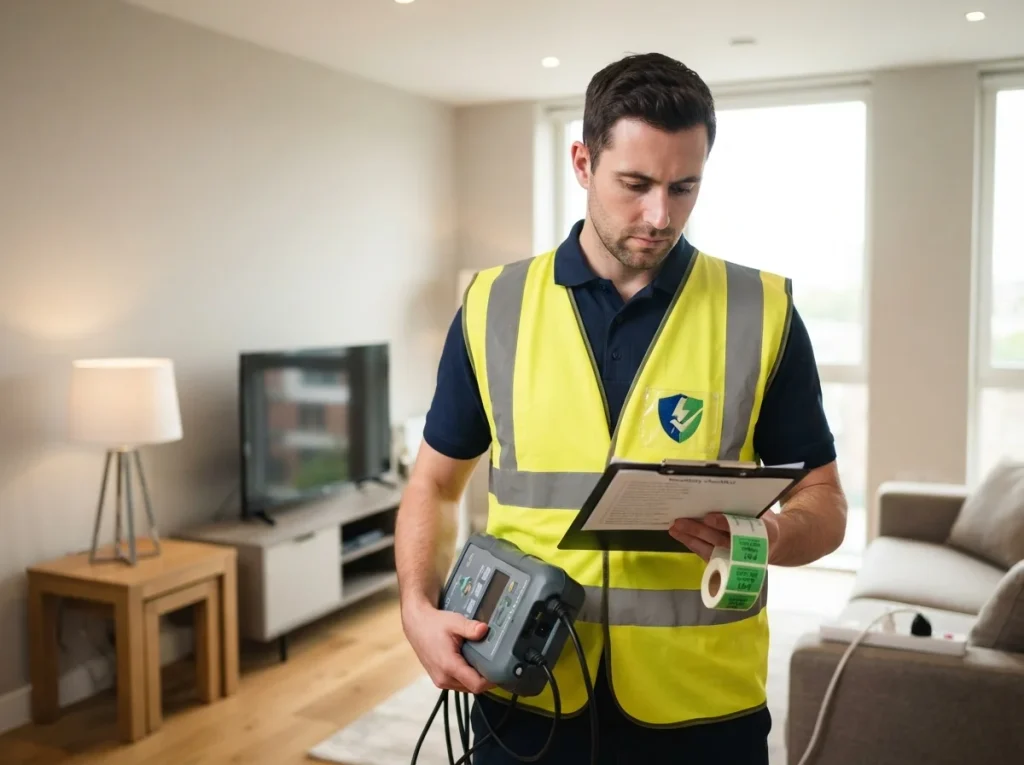
A PAT test visit is a straightforward, room-by-room process that rarely disrupts tenants. The tester checks each supplied appliance in turn, labels it, and issues a report once every item is done. A typical furnished flat takes well under an hour.
To keep things quick:
- Give tenants at least 24 hours’ notice, as required for access
- Ask tenants to leave supplied appliances unplugged and reachable
- Share your inventory so the tester knows which items are yours
- Pull the fridge or washing machine forward slightly if the plug is hidden
Each appliance is switched off briefly while it’s being tested, so it’s worth warning tenants about anything they’d rather not interrupt. If you’re unsure what a visit involves, call 0203 633 9146 and we’ll talk you through it.
Pass and Fail Labels Explained
Every tested appliance gets a label. A pass label shows the test date, a unique appliance ID, the tester’s initials and the recommended retest date.
A fail label means the item is unsafe and must stop being used straight away. The tester disconnects it, and you then decide whether to repair and retest it or replace it. Minor faults such as a wrong fuse or loose plug terminal can often be fixed on the spot.
What Your PAT Test Report Should Include
A proper PAT test report, sometimes called a PAT certificate, lists every appliance tested. Check that yours shows:
- Appliance ID, description and location in the property
- Appliance class
- Individual test readings, not just “pass”
- Pass or fail result for each item
- Tester’s name and qualification
- Test date and recommended retest date
Keep reports for at least the length of the tenancy, and ideally longer. They’re your evidence if an insurer, council or tenant ever questions appliance safety.
Who Can Carry Out PAT Testing?
A “competent person” must carry out PAT Testing, which in practice means someone trained to interpret results and equipped with a calibrated tester. The standard industry qualification is City and Guilds 2377, which covers the IET Code of Practice in full.
Landlords can legally do their own visual checks between formal tests. Without training and a calibrated instrument, though, a DIY electrical test carries little weight with insurers or licensing officers.
One specialist case worth knowing: supported living and adapted properties sometimes include medical electrical equipment such as hoists or profiling beds. These are tested to BS EN 62353, a separate standard that needs a tester with the right experience.
Simple Checks Tenants Can Do Between Tests
A short “user check” note in your tenant welcome pack costs nothing and catches problems early. Ask tenants to report:
- Damaged or frayed cables
- Plugs that feel warm or show scorch marks
- Appliances that trip the electrics or give a tingle
- Extension leads daisy-chained together or overloaded
The Bottom Line on PAT Testing
PAT Testing is your proof that every appliance you hand to a tenant was safe on the day it was checked. A visual inspection and a short series of electrical tests confirm the earth, insulation and wiring are sound, and each item gets a dated label.
For HMOs, PAT Testing is frequently a licence condition, and missing it can lead to a civil penalty. For every other let, it turns a vague legal duty under the Electrical Equipment (Safety) Regulations 2016 into a clear paper trail.
Testing at each change of tenancy, or every 12 months for HMOs, keeps that evidence current. It’s a quick visit that protects both your tenants and your position if anything goes wrong.
PAT Testing With EICR Landlord Cert
EICR Landlord Cert carries out PAT Testing for landlords, letting agents, HMO operators and property managers across all 32 London boroughs from our office at 128 City Road, EC1V 2NX. Our City and Guilds 2377 qualified testers are DBS checked and covered by public liability insurance, and PAT Testing starts from £69 with same-day inspections often available. Every appliance receives a pass or fail label and appears in a full digital report, and you can book by calling 0203 633 9146, Monday to Friday, 9:00 AM to 6:00 PM.
Frequently Asked Questions About PAT Testing
What is PAT Testing?
PAT Testing, or portable appliance testing, is a routine safety check on electrical appliances that plug into the mains. A competent tester visually inspects each item, then uses a calibrated PAT tester to check earth continuity, insulation resistance and current leakage.
Each appliance receives a pass or fail label, and the results are recorded in a report. Landlords use PAT Testing to prove that appliances supplied with a rental property are safe, in line with the Electrical Equipment (Safety) Regulations 2016.
Is PAT Testing a legal requirement for landlords?
PAT Testing isn’t specifically required by law for most single-household lets in England and Wales. However, landlords must keep supplied appliances safe under the Electrical Equipment (Safety) Regulations 2016 and the Consumer Protection Act 1987.
Many councils make PAT Testing a condition of HMO licences, with civil penalties of up to £30,000 for breaches. In Scotland, government guidance requires landlord-supplied appliances to be PAT tested at least every five years.
What appliances need PAT Testing in a rental property?
Every electrical appliance a landlord supplies should be PAT tested. This includes kettles, toasters, microwaves, fridges, washing machines, tumble dryers, vacuum cleaners, electric heaters, lamps, televisions and extension leads.
Appliances left behind by a previous tenant become the landlord’s responsibility if they stay in the property. Items belonging to the current tenant, such as their own laptop or hairdryer, don’t need testing by the landlord.
How often should PAT Testing be done?
No law sets a fixed interval for PAT Testing. The IET Code of Practice recommends a risk-based approach, so frequency depends on the type of appliance and how it’s used.
Most landlords test at every change of tenancy, while HMO landlords typically test every 12 months because communal appliances see heavier use. Always check your HMO licence, as some councils specify an exact interval.
How long does PAT Testing take?
Each appliance usually takes between two and five minutes to test, including the visual inspection, electrical tests and labelling. A furnished one-bedroom flat with ten to fifteen appliances typically takes under an hour.
Larger HMOs with shared kitchens take longer. To book a visit, call 0203 633 9146 and give tenants at least 24 hours’ notice so appliances are accessible on the day.
What is included in a PAT test?
A PAT test includes a formal visual inspection of the casing, cable, plug and fuse, followed by electrical tests suited to the appliance class. Class I appliances get an earth continuity test, and both Class I and Class II appliances get an insulation resistance test and a leakage or touch current test. Extension leads also get a polarity check. Every item is labelled and recorded in a written report.
What are the pass and fail criteria for PAT Testing?
Pass and fail limits come from the IET Code of Practice for In-service Inspection and Testing of Electrical Equipment. A Class I appliance needs an earth continuity reading of no more than 0.1 ohms plus the cable resistance, and an insulation resistance of at least 1 megohm.
Class II appliances need at least 2 megohms. Any visible damage, such as a frayed cable or scorched plug, is an automatic fail regardless of the readings.
How long is a PAT test certificate valid?
A PAT test certificate has no fixed legal expiry date. It confirms the appliances were safe on the day of testing, and each label shows a recommended retest date based on the appliance type and environment.
For rental properties, most landlords retest at each new tenancy or every 12 months for HMOs. An outdated report offers weak evidence if an appliance later causes harm.